
Last updated October 9, 2026
Free on-site gate assessment - hinges, posts, and your LiftMaster or Nice gate operator checked before anything is quoted
The assessment is free and the quote is the invoice.

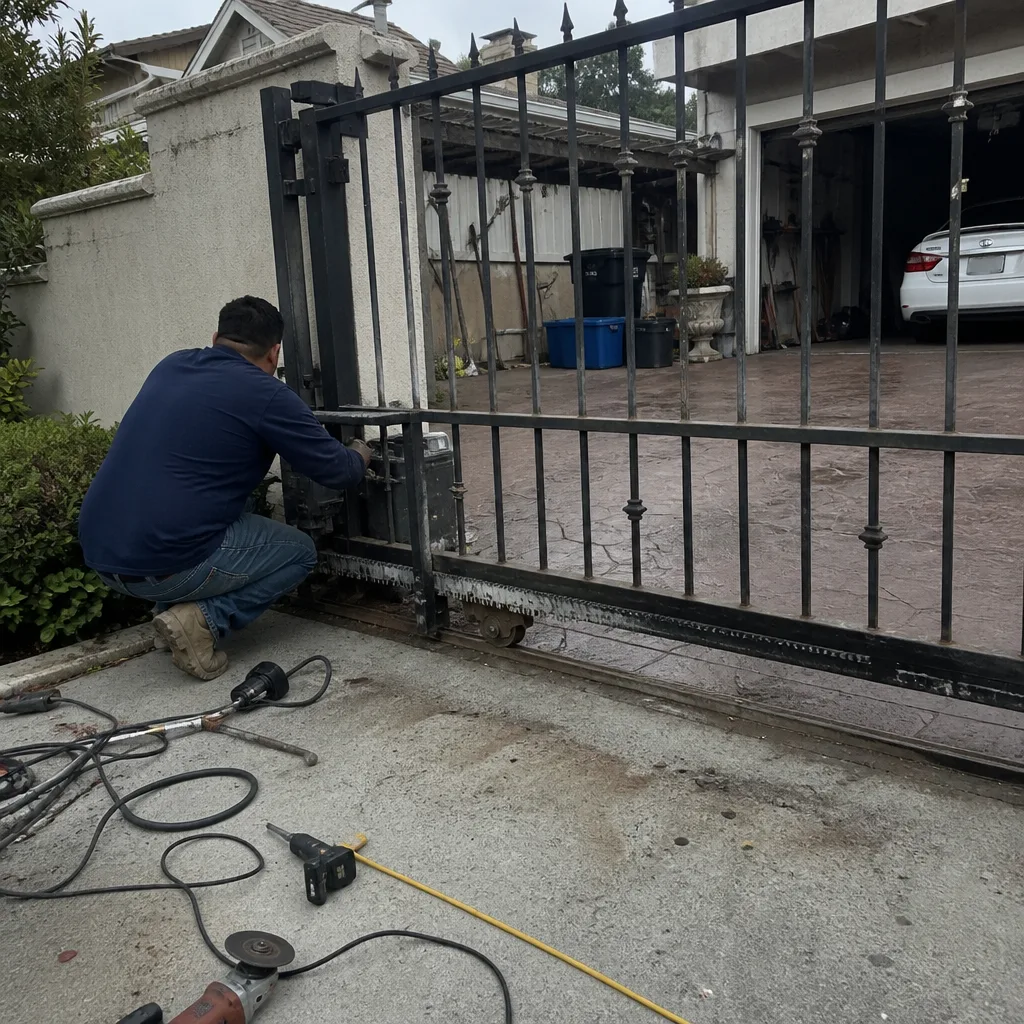 Before
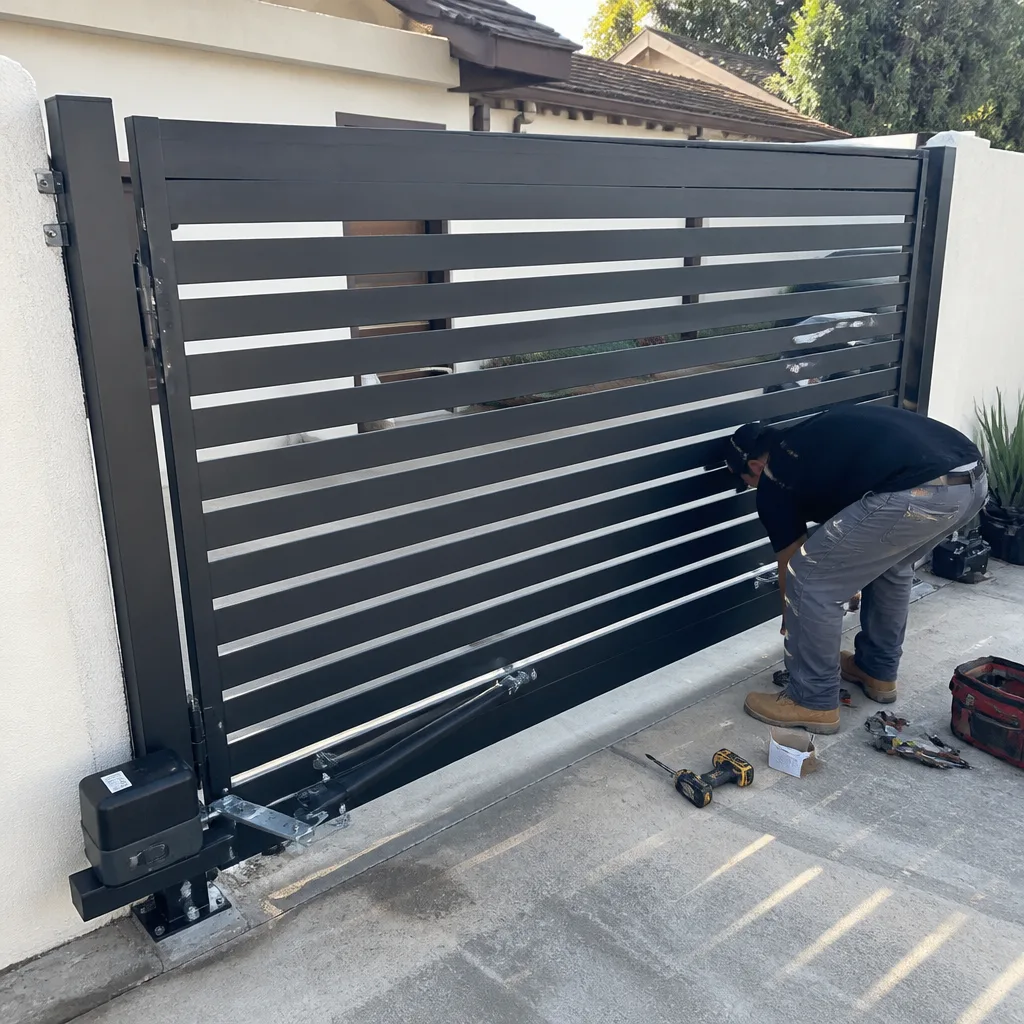 After
After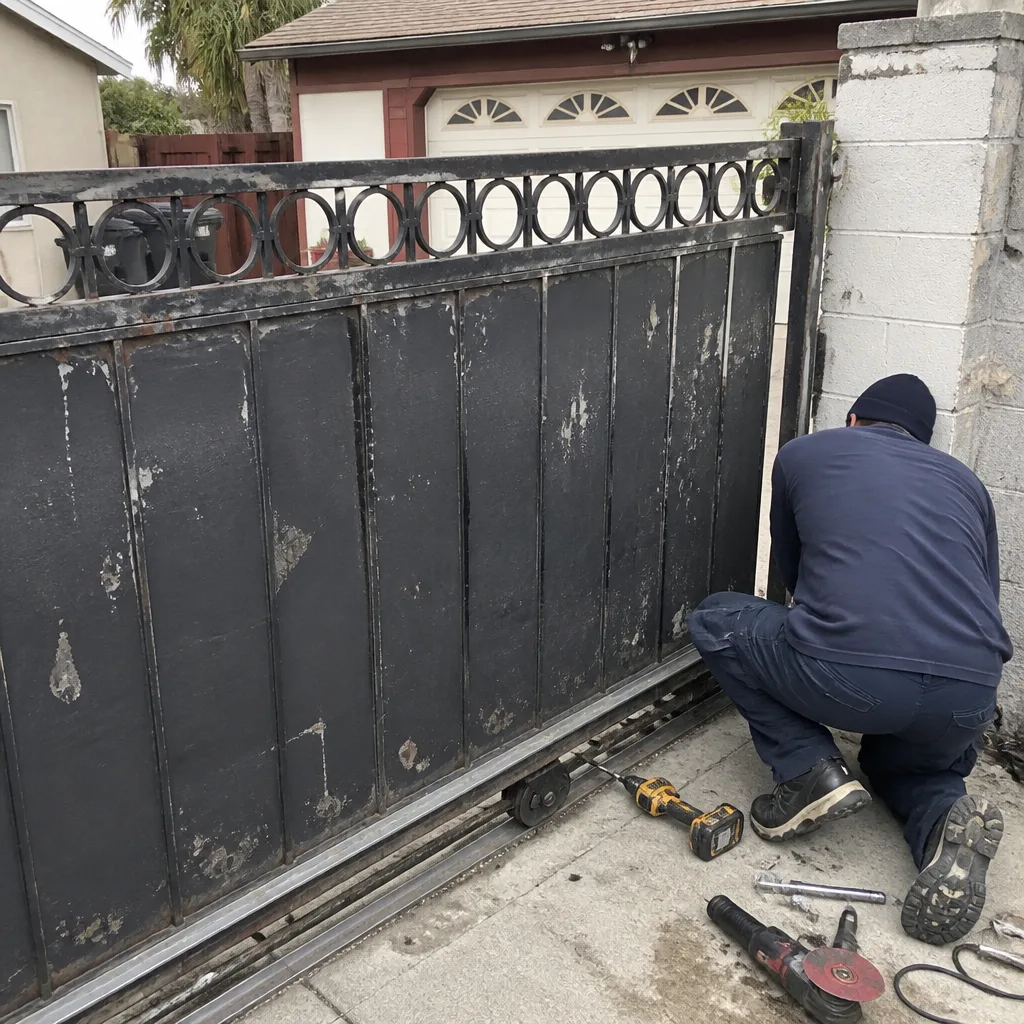 Before
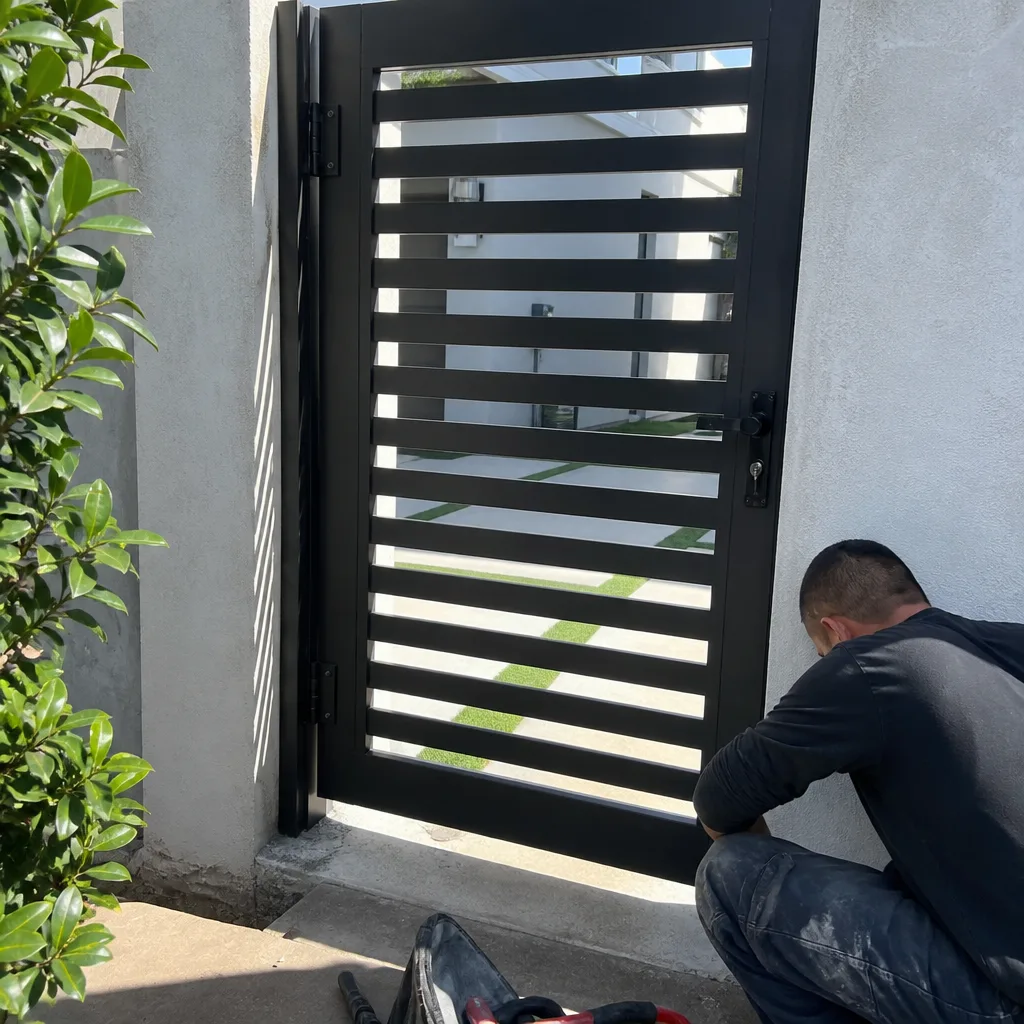 After
After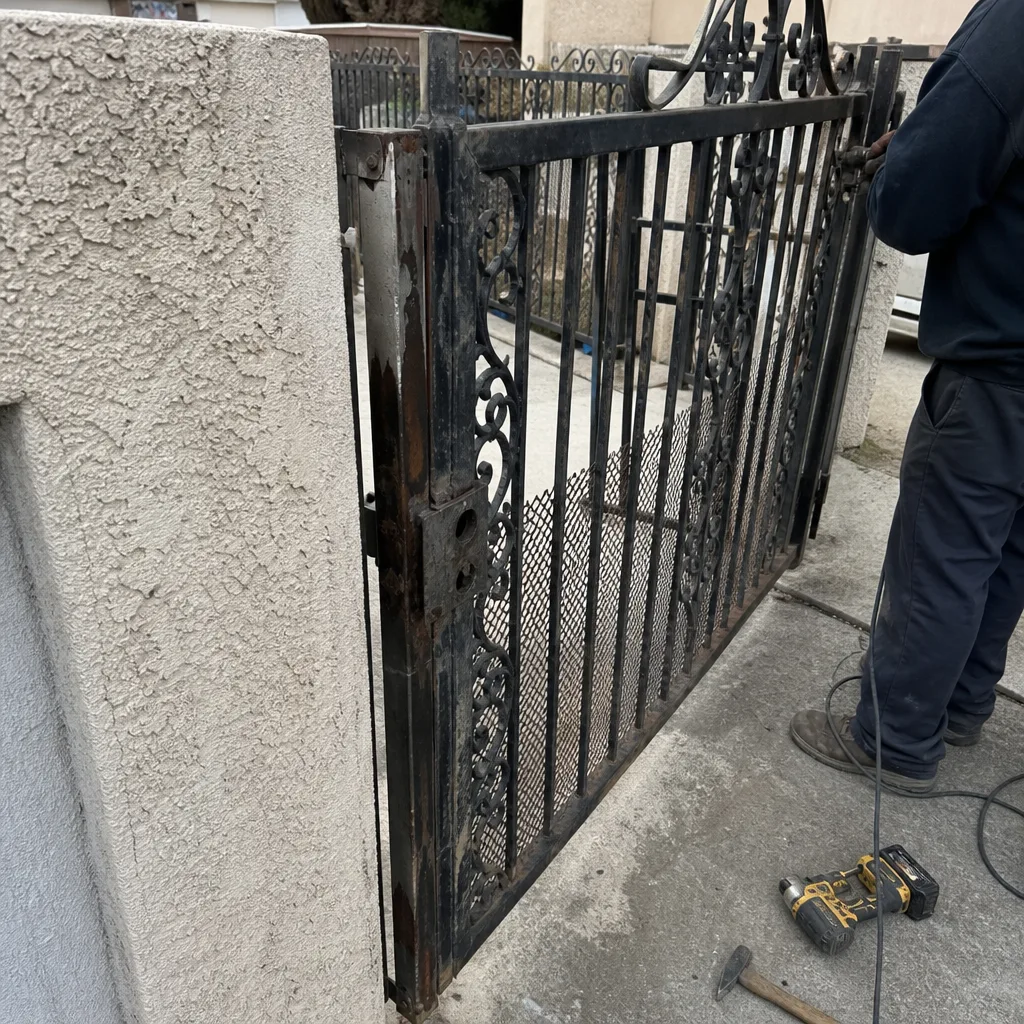 Before
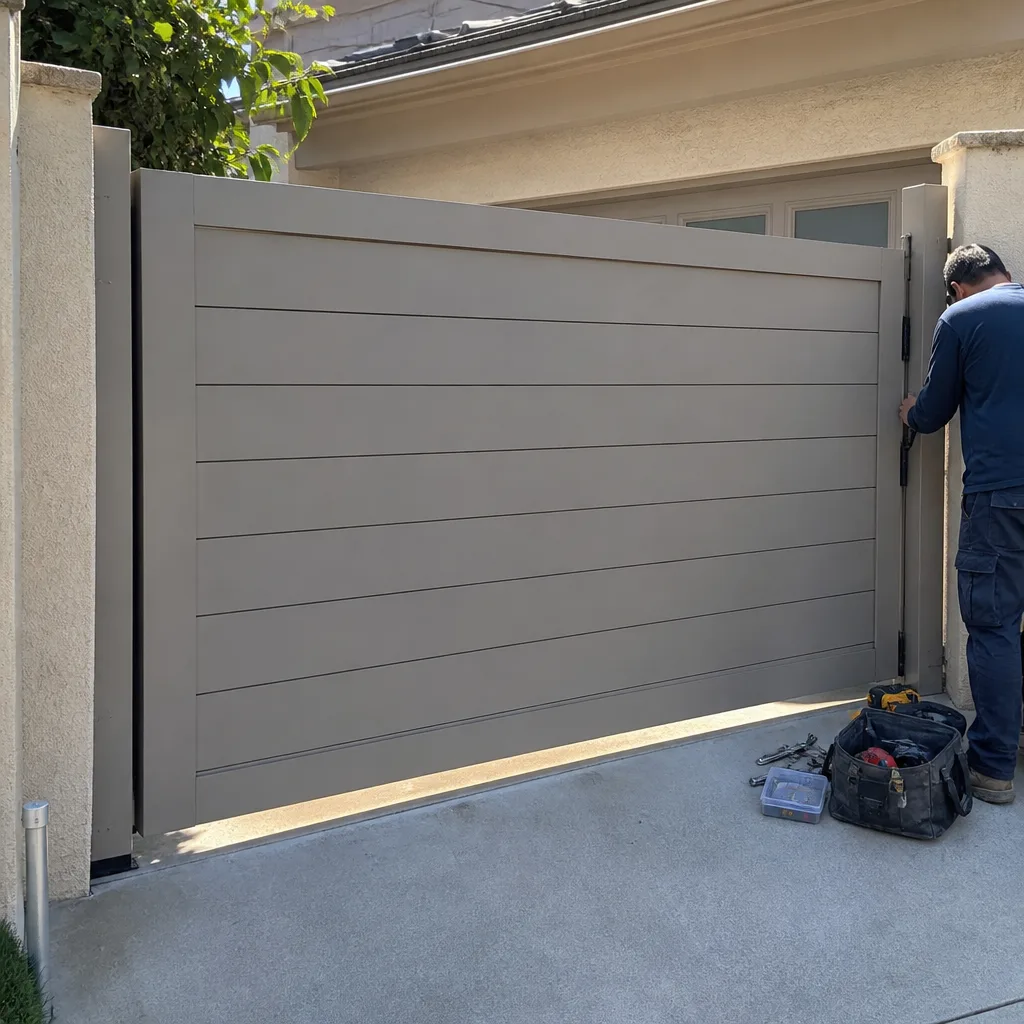 After
AfterHow Long Does Electric Gate Repair Take? Timelines and What to Expect
The repair itself rarely takes more than 90 minutes. What actually eats your week is the space between “the gate stopped working” and “a technician is standing in front of it” – the diagnostic back-and-forth, the part that wasn’t on the truck, the second trip that shouldn’t have been necessary. In Los Angeles, where a gate is often the first line of defense for a driveway off a busy street, that gap matters more than most people realize. This guide maps the real clock: what happens during each phase of an electric gate repair, which jobs finish same-day, which ones legitimately take longer, and what you can do before you call to compress the timeline. By the end, you’ll know exactly what to expect, what questions to ask, and what vague language from a repair company actually signals.
Quick Answer
Most electric gate repairs in Los Angeles take between 60 and 120 minutes of on-site labor once the technician arrives. Same-day repair is common for mechanical issues like broken chains, misaligned sensors, or failed loop detectors. Jobs requiring a specialty control board or a motor swap for a less common brand can stretch to 2 – 5 business days because the part has to be sourced first. The single biggest time variable is diagnosis, not labor – and a homeowner who provides the brand name, model number, and a short video before the visit can often eliminate an entire return trip.
Table of Contents
- The Three Phases of Every Electric Gate Repair
- Same-Day vs. Multi-Day Repairs: Know the Difference
- Labor Timelines by Repair Type
- Part Sourcing in Los Angeles: Why It Sometimes Takes Days
- Cut Your Repair Time in Half: What to Gather Before You Call
- What a Written Time Estimate Should Include
- How Los Angeles Specifically Affects Your Repair Timeline
- Common Mistakes to Avoid
- When to Call a Professional
- Frequently Asked Questions
- The Bottom Line
The Three Phases of Every Electric Gate Repair
When a gate won’t open, homeowners tend to think of the repair as one event. In practice, every electric gate repair breaks into three distinct phases, and each one has its own clock. Understanding this is the difference between a realistic timeline and a frustrating one.
Phase one is diagnosis. This is the part most people don’t budget time for, because they assume the technician will show up and immediately know what’s wrong. Often they do, especially with experience on a specific brand. A BFT sliding gate that’s grinding, a FAAC operator that hums but doesn’t move, a Linear opener that trips its breaker – these have known failure patterns. But sometimes the problem is intermittent, or it’s a wiring issue inside conduit that runs under a driveway, or the gate worked fine until 6 AM this morning and now it won’t budge. Diagnosis on-site typically takes 20 to 45 minutes. A technician working through a systematic checklist – power, control board, safety inputs, mechanical load – will find the root cause rather than treating a symptom and leaving a time bomb.
Phase two is part sourcing. If the failed component is common – a capacitor, a limit switch, a receiver board, a chain, a wheel – the truck is usually stocked and the repair proceeds immediately. If it’s a proprietary control board for a specific Viking model from 2016, or a gearbox for an older FAAC unit, the part may need to come from a distributor. In Los Angeles, that’s often same-day or next-day if the distributor is local. But not every part is stocked locally, and a board that ships from a regional warehouse can add two to four days.
Phase three is labor. The actual wrenching. Most mechanical repairs – replacing a chain, adjusting a limit switch, realigning a photo eye, swapping a loop detector – take under an hour. A full gate motor replacement on a sliding gate might take 90 minutes to two hours with two technicians. The labor itself is rarely the bottleneck. The diagnostic and sourcing phases are where days disappear.
Same-Day vs. Multi-Day Repairs: Know the Difference
Here’s the breakdown most companies won’t give you upfront because it depends on what’s actually broken. In our experience across Los Angeles, from the hillside driveways of Silver Lake to the gated communities of Porter Ranch, repairs fall cleanly into two buckets.
Same-day repairs (resolved in one visit, typically 60 – 120 minutes on-site):
- Broken loop detector: The sensor buried in the driveway that tells the gate a car is waiting. Replacement takes about 30 minutes including testing.
- Snapped chain or belt: Common on sliding gates with years of daily cycles. A stocked chain and sprocket set goes in within an hour.
- Misaligned safety photo eyes: The sensors that prevent the gate from closing on a car or a child. Realignment is usually a 15-minute fix.
- Remote or keypad resync: If the receiver is fine and only the programming drifted, this is a 20-minute service call.
- Blown capacitor on the gate motor: The motor hums but can’t start. A replacement capacitor takes under 30 minutes if it’s on the truck.
- Bent or seized gate wheel: The gate drags or binds. Replacing one or two wheels is straightforward mechanical work.
Multi-day repairs (diagnosis on day one, repair on a follow-up visit):
- Dead control board on a less common brand or older model: If the board for your Viking or BFT unit isn’t in local stock, expect 2 – 5 business days.
- Gate motor replacement on a custom or oversized gate: The motor may need to be ordered to match the gate’s weight and duty cycle. This is a measured job, not an emergency dispatch.
- Underground wiring fault: Finding a break in conduit under a driveway requires tracing equipment and possibly trenching. This is the rare repair that can legitimately span multiple days.
- Custom hinge or fabrication work: If the gate itself is physically damaged and needs welding or custom parts, that’s a scheduled project with its own timeline.
The key distinction: if the failure is mechanical and the part is common, you’re likely done same-day. If electronics are involved and the exact model matters, patience is required – and a technician who tells you that honestly is worth more than one who promises a miracle and disappears.
Labor Timelines by Repair Type
Here’s what realistic on-site labor looks like for the repairs we handle most often. These are ranges from actual jobs, not optimistic estimates. Los Angeles homes range from 1940s bungalows with original steel gates to new builds with modern automation, and the age of the installation always affects the clock.
- Loop detector replacement: 30 – 45 minutes. The old detector is pulled, the new one seated, sensitivity tuned, and a test cycle run with a vehicle.
- Chain replacement on a sliding gate: 45 – 75 minutes. Includes sprocket inspection, chain tensioning, and a full open-close cycle test.
- Safety photo eye realignment or replacement: 20 – 40 minutes. The eyes must be parallel and clean; if the conduit is damaged, add time for rewiring.
- Remote control and keypad programming: 15 – 30 minutes per device. This includes verifying the receiver frequency and clearing old codes.
- Capacitor or start relay replacement on the gate motor: 25 – 40 minutes. Requires discharging the capacitor safely first – not a DIY job.
- Control board replacement: 45 – 90 minutes. This includes disconnecting power, swapping the board, restoring all settings, and testing every input: remote, keypad, loop, safety edges, and obstruction sensors.
- Full gate motor replacement (sliding gate): 90 – 150 minutes. The old motor comes out, the new one is mounted, the chain or belt is attached, limits are set, and the full safety system is verified.
- Full gate motor replacement (swing gate): 60 – 120 minutes per leaf. Swing gates with two leaves take longer because both arms must be synchronized.
None of these numbers include travel time to your property. In Los Angeles, where a technician might cover Westchester in the morning and Pasadena in the afternoon, scheduling is built around traffic windows, not just availability. A company that gives you a two-hour arrival window is being honest about the 405 and the 10 and the 101 in a way that a company promising exact arrival times is not.
Part Sourcing in Los Angeles: Why It Sometimes Takes Days
Los Angeles is one of the best-supplied cities in the country for gate parts, but that doesn’t mean every part is sitting on a shelf down the street. The reality depends on the brand and the component.
For the major brands – LiftMaster, FAAC, BFT, Linear, Viking, Ghost Controls, DoorKing, Elite, and Mighty Mule – common replacement parts are stocked by distributors in the San Fernando Valley, Vernon, and the Inland Empire. A control board for a current-model FAAC swing gate operator can often be picked up same-day or delivered the next morning. That’s why a same-day diagnosis can still become a next-day repair without anyone doing anything wrong.
Older or discontinued models are a different story. A Viking operator from a decade ago might have a board that’s no longer manufactured, which means sourcing a refurbished unit or retrofitting a current board with an adapter. That’s a 3 – 7 business day reality, and it’s the kind of timeline you want to hear about on day one, not day four.
What this means for you: if your gate is older or the brand is less common, expect the part sourcing phase to be the longest leg of the journey. A technician who carries a deep truck stock can often bypass this entirely for the most common failures. A technician who doesn’t will order the wrong part, wait for it to arrive, install it, discover it wasn’t the actual problem, and start over. That’s the difference between a two-hour repair and a two-week saga.
Cut Your Repair Time in Half: What to Gather Before You Call
Here’s the section worth printing out and taping inside your gate control box. The information you provide before the technician arrives directly determines whether your repair is a one-visit job or a two-visit job. Most of the delay in electric gate repair isn’t the repair itself – it’s the discovery process that happens after the technician shows up and starts from zero.
Step one: Find the brand name and model number. The gate motor – the box that slides or swings your gate automatically – has a nameplate on it. LiftMaster, FAAC, BFT, Linear, Viking, Ghost Controls, DoorKing, Elite, Mighty Mule – the name is right there. The model number is usually on the same plate. Take a photo of it with your phone. This single piece of information tells the technician what parts are likely needed and whether they’re already on the truck.
Step two: Note exactly what the gate does when it fails. Does it hum but not move? Does it move a few inches and stop? Does it open but not close? Does it trip a breaker? Is the problem constant or intermittent? Does it only happen when it rains? These are diagnostic gold, and writing them down before the visit saves 20 minutes of on-site trial and error.
Step three: Record a 30-second video of the gate attempting to operate. This is the single most effective thing you can do. A clear video showing the symptom – the sound, the hesitation, the partial movement – gives an experienced technician a running start before they even leave the warehouse. In many cases, we’ll know the likely failure from the video alone and arrive with the right part in hand.
Step four: Locate the breaker or disconnect switch for the gate. It’s usually in a separate box near the motor or on a wall inside the garage. Knowing where it is saves the technician from hunting for it and lets you kill power to the gate if instructed during initial troubleshooting. Don’t touch high-voltage components yourself – a gate motor runs on household current and a capacitor can hold a dangerous charge even after the power is off. But knowing where the disconnect is keeps things moving.
Step five: Check your gate’s manual or the previous repair invoice if you have one. If the same issue happened before, that history tells the technician whether a part is failing repeatedly – which points to a root cause, not a symptom.
When you call a company with this information in hand, you’re not just a service request. You’re a partner in the diagnosis, and that partnership is what turns a two-visit repair into a one-visit repair.
What a Written Time Estimate Should Include
A legitimate time estimate is a specific promise, not a shrug. Here’s what it should contain, and here’s what vague language reveals about the company you’re talking to.
A written time estimate should include:
- Arrival window: Not “sometime today” but “between 9:00 AM and 11:00 AM.” Los Angeles traffic makes exact arrival times unreliable, but a two-hour window is standard for a professional operation.
- Diagnosis time: How long the technician expects to spend finding the problem. Typically 20 – 45 minutes.
- Repair time, if the problem is confirmed: This should be a range, not a single number. “60 to 90 minutes for a chain replacement” is honest. “About an hour” is a guess.
- Part availability status: Whether the likely part is on the truck, at a local distributor, or needs to be ordered. If the company hasn’t asked for your gate’s brand and model, they can’t possibly know this yet.
- Contingency plan: What happens if the problem is bigger than expected. A professional says, “If we find the board is dead, we’ll order it today and schedule the install for 48 hours out.” An amateur says, “We’ll figure it out when we get there.”
What vague language like “a few hours” actually signals: It signals that the person giving the estimate hasn’t asked enough questions to give a real answer. “A few hours” is what you say when you don’t know whether the part is in stock, whether the technician has worked on a FAAC before, or whether the job is a capacitor or a full rewire. It also signals that you might wait through a whole afternoon and still not have a working gate. Every job Warden Gate Repair performs gets a written price before any work starts – and that written price includes a time commitment, because time is part of the cost. A company that refuses to commit to a timeline is usually a company that hasn’t earned the right to commit to a price.
How Los Angeles Specifically Affects Your Repair Timeline
Los Angeles isn’t a generic market, and your gate repair timeline isn’t a generic number. Three local factors shape how long things actually take here.
Traffic is the silent multiplier. A technician building a route across Los Angeles is solving a puzzle every morning. The difference between a 10:00 AM arrival in Woodland Hills and a 10:00 AM arrival in Echo Park is not geography – they’re 20 miles apart – it’s 45 minutes of Sepulveda Pass or 25 minutes of surface streets. A company that covers the whole metro honestly has to give windows, not promises, and anyone who tells you “we’ll be there at exactly 2:15” is either lying or only serving one neighborhood. Warden Gate Repair gives a two-hour arrival window and a phone call when the technician is en route, with the technician’s name and photo sent before the visit.
The supply chain is close, but not instant. Los Angeles has major gate parts distributors in the Valley and the industrial corridor south of downtown. For common parts on current models, a morning diagnosis can become an afternoon fix. For specialty boards and older equipment, the part is often coming from a regional warehouse or from the manufacturer directly. Expect 2 – 5 business days when the part isn’t local, and expect a company that tells you this truth on the initial call rather than after you’ve already paid a diagnostic fee.
Age and condition of LA housing stock varies wildly. A gate on a 1960s ranch house in the San Fernando Valley may be running on original conduit and wiring. A gate on a spec home in Playa Vista is likely a modern BFT or FAAC unit with current parts availability. We’ve seen sliding gates in Los Angeles that date back to the original build and have had five different motors mounted on the same track. The older the installation, the more likely the repair involves chasing a wiring fault or adapting a current part to an old frame – and the more important the pre-call information gathering becomes.
For Los Angeles readers who want more specific information about service in their area, see our Gate Repair in Los Angeles page or the detailed breakdown on Electric Gate Repair in Los Angeles. If the motor itself is the issue, Gate Motor Repair in Los Angeles covers that in depth. And for the complete picture of who we are and how we work, start at the Warden Gate Repair home page.
Common Mistakes to Avoid
- Calling a general handyman instead of a gate specialist. A gate motor is a specific piece of equipment with brand-specific failure modes. A handyman who “can probably figure it out” will spend your time and money learning on your gate. In Los Angeles, where hundreds of companies claim to do gate work, the question to ask is: “Which brands do you carry parts for on the truck?”
- Resetting the breaker repeatedly without addressing the cause. If your gate trips a breaker, something is overloading the circuit. Flipping the breaker back on five times doesn’t fix it – it overheats the motor and can damage the control board. One reset is diagnostic. Five resets is expensive.
- Not writing down what the gate was doing when it failed. Intermittent problems are the hardest to diagnose, and the technician can only see what’s happening during the visit. Your notes about rain, time of day, and exact symptoms are often the difference between finding the fault and guessing at it.
- Ignoring a gate that’s getting slower or louder. Gates rarely fail without warning. A gate that’s been grinding for three months and finally stops has been telling you something. Scheduling a repair when the symptom first appears is always shorter and cheaper than waiting for the full failure.
- Hiring on price without checking what the price includes. A $39 service call that becomes a $900 repair after the technician arrives is not a $39 service call. Ask what the diagnostic covers, whether the repair quote is written before work starts, and whether the parts brand matches your existing equipment.
- Not asking about the guarantee before agreeing to the work. Every repair should come with a written guarantee. If the company can’t tell you what the warranty period is before they start, that’s your answer. Warden Gate Repair backs every job with the 365-Day Done Right Promise: if the repair isn’t right, we make it right with a free return visit.
- Assuming all gate motors are interchangeable. They’re not. A slide gate and a swing gate use different operator types. Within a brand, duty cycles vary. The wrong motor on a heavy gate fails in months, not years. This is why brand-specific experience matters, and why a shop that works on nine major brands – LiftMaster, FAAC, BFT, Linear, Viking, Ghost Controls, DoorKing, Elite, and Mighty Mule – can match the right part to the right gate.
When to Call a Professional
Call a professional when the gate won’t open or close reliably, when the motor hums but doesn’t move, when the gate reverses unexpectedly, when the safety sensors won’t stay aligned, or when you hear a new sound – grinding, screeching, popping – that wasn’t there before. These are not annoyances to live with. A gate that malfunctions can damage vehicles, injure people or pets, and leave your property unsecured. Also call when you’ve had the same repair done twice in the past year: repeating failures mean the root cause hasn’t been found. The safety edges, photo eyes, and obstruction detection on an electric gate are life-safety systems, and they need to work every single time. Warden Gate Repair offers free estimates in Los Angeles – call (828) 426-7081 – and check our more guides & resources for additional help. We’ll give you a written price before any work starts, and you’ll know exactly who’s coming to your door before they arrive.
Frequently Asked Questions
Most electric gate repairs take 60 to 120 minutes of on-site labor once the technician is on-site. The total elapsed time from your first call to a working gate depends on diagnosis and part availability, which is why same-day repairs are common for mechanical issues while electronic components like control boards may add 2 – 5 business days for sourcing. Call (828) 426-7081 for a free estimate on your specific gate.
Same-day repair is often possible when the failure is mechanical – a snapped chain, a misaligned sensor, a failed loop detector – and the part is standard. Same-day repair is less likely when the problem is a proprietary control board or an uncommon motor that isn’t stocked on the truck. We’ll tell you honestly which category you’re in during the initial call, based on the brand name and symptoms you provide.
Electric gate repair costs in Los Angeles typically range from $150 to $400 for common repairs like loop detectors, safety sensors, and chain replacement, while control board replacement or full gate motor replacement ranges from $600 to $1,800 depending on the brand and model. Every Warden Gate Repair job gets a written price before work starts, no exceptions. Call (828) 426-7081 for an exact quote – estimates are free.
Find your gate’s brand name and model number from the motor nameplate, write down exactly what the gate does when it fails, record a 30-second video of the symptom, note where the breaker or disconnect switch is located, and have any previous repair invoices handy. These five things can eliminate an entire return visit and cut your total repair time substantially.
Control boards are brand- and model-specific, and not every board is stocked locally in Los Angeles. A board for a current FAAC or BFT model may be available from a distributor the same day, but a board for an older Viking or an out-of-production Linear unit can take 2 – 5 business days to source. A technician who asks for your model number before scheduling is already working to shorten that clock.
Every repair Warden Gate Repair performs is guaranteed in writing for 365 days. If the repair fails within that year, we return and make it right at no charge – the return visit is included in every job. If a gate or opener can’t be repaired, a replacement is recommended with a written quote before any new work begins. That’s the entire promise: done right, or we come back.
The Bottom Line
Electric gate repair in Los Angeles usually takes under two hours of actual labor, but the total timeline depends on three phases: diagnosis, part sourcing, and the repair itself. Mechanical failures are typically same-day jobs. Electronic failures on less common brands are multi-day realities, and the honest companies will tell you that up front. You can compress the timeline significantly by gathering the brand name, model number, symptom description, and a short video before your first call – that information often converts a two-visit repair into a one-visit repair. The right company gives you a written price before work starts, a written time estimate, and a technician whose name and photo you see before they arrive. That’s the whole Warden Gate Repair home standard, and it’s the difference between a gate that gets fixed and a gate that gets guessed at.
Written by Cole Rafferty, Owner at Warden Gate Repair, serving Los Angeles since 2008.