
Last updated October 9, 2026
Free on-site gate assessment - hinges, posts, and your LiftMaster or Nice gate operator checked before anything is quoted
The assessment is free and the quote is the invoice.

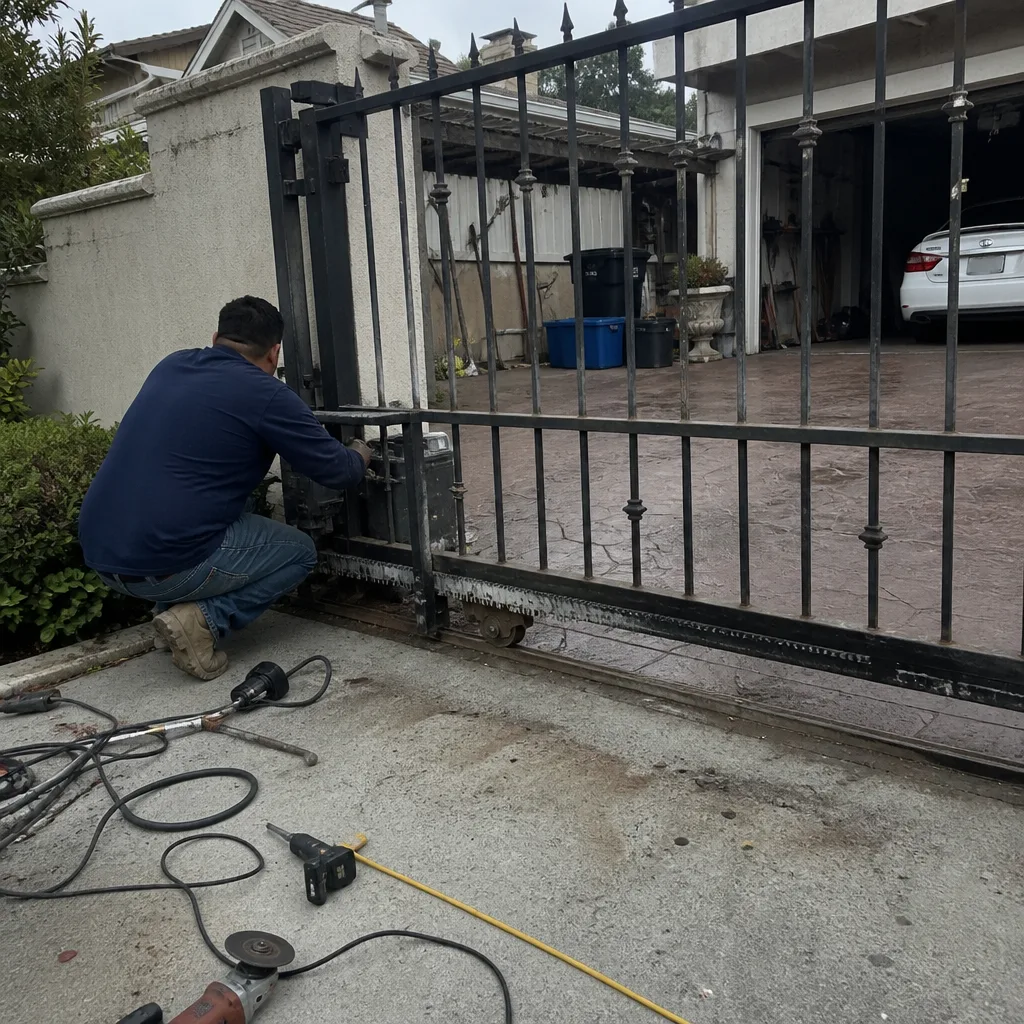 Before
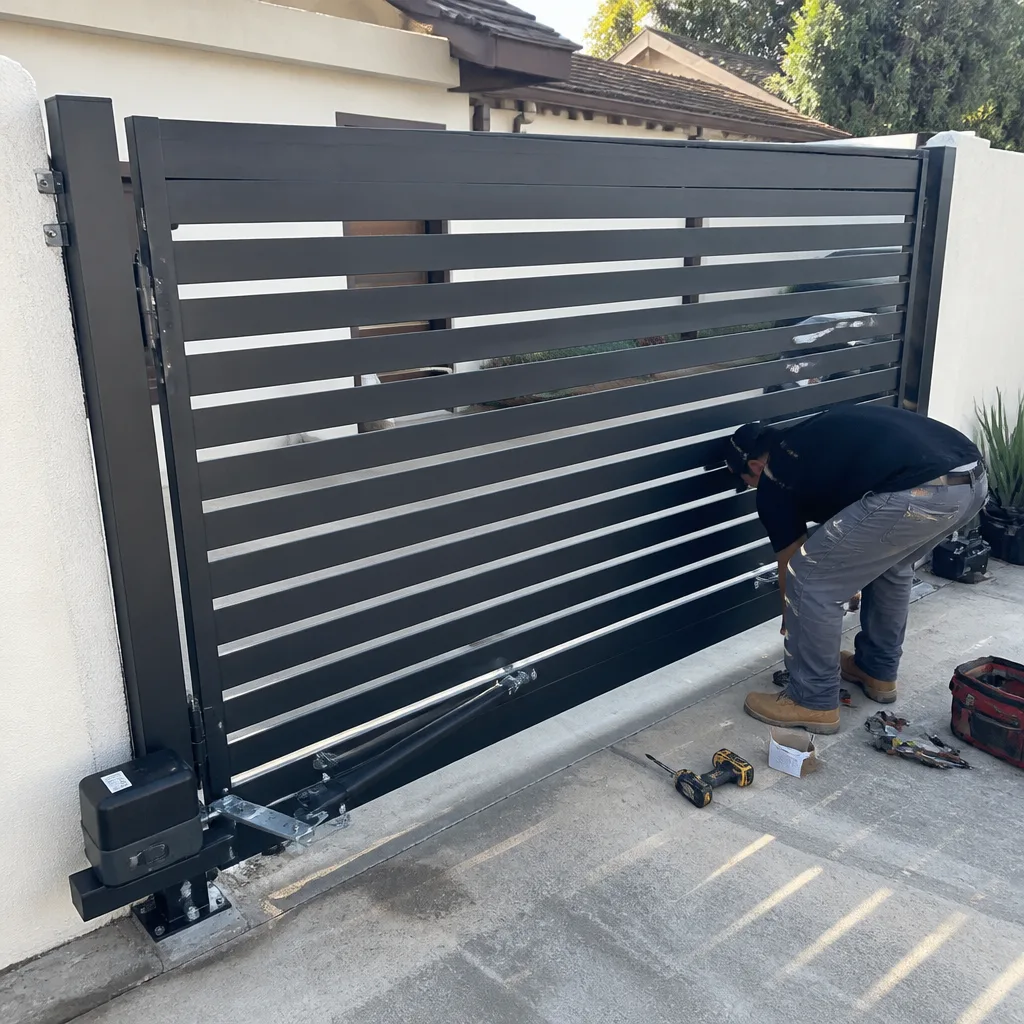 After
After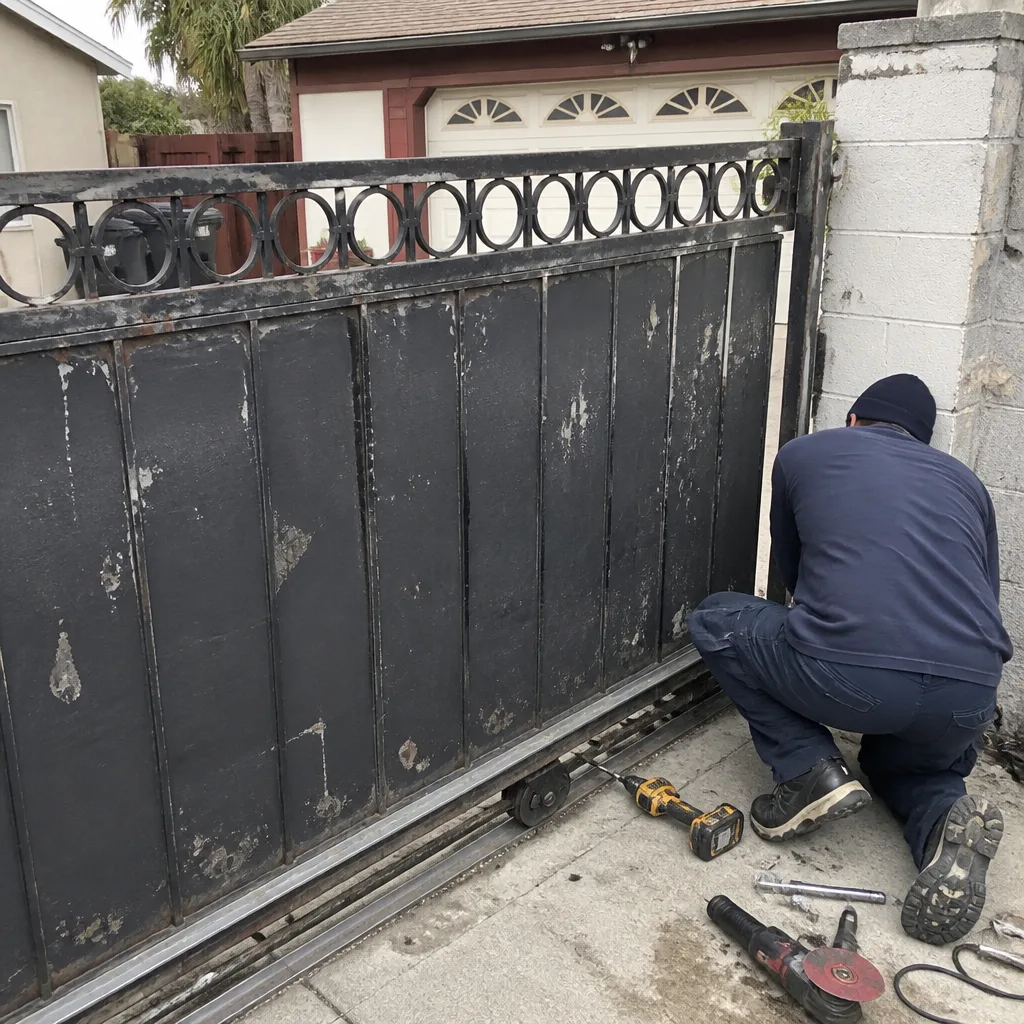 Before
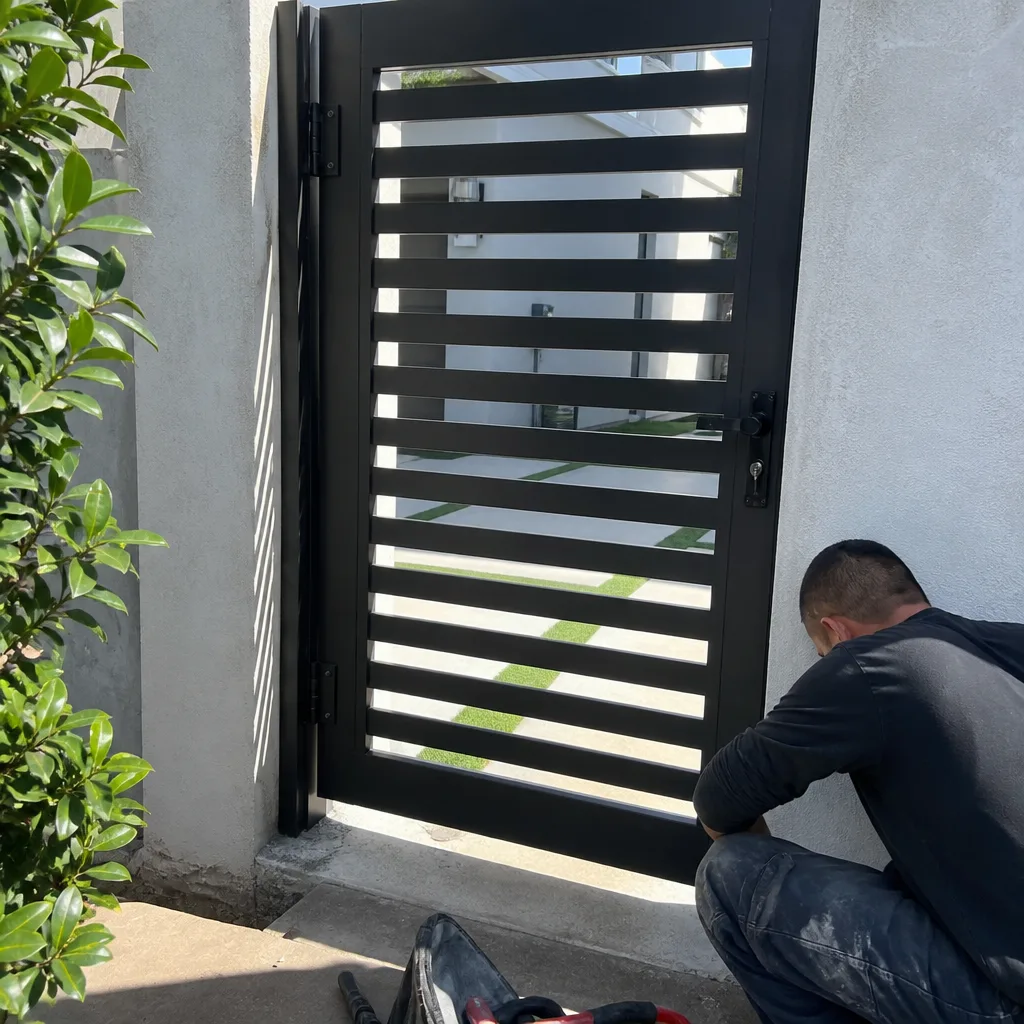 After
After Before
 After
AfterGate Motor Repair Maintenance Schedule: What to Do and When
Here’s the counterintuitive thing about gate motors: the failure that finally kills them usually started six months earlier as a task that takes four minutes and a hex key. In Los Angeles, where a gate can cycle 20 to 40 times a day on a busy street, the motor that gets a defined maintenance schedule routinely lasts 12 to 15 years. The one that only gets attention after it stalls typically dies at 6 to 8. And the task most homeowners skip, manually releasing the gate and checking the force settings, is the exact one that causes motors to burn out prematurely. This guide gives you the full schedule, month by month, with the right lubricant for each component, the correct way to test the auto-reverse, and a maintenance log that protects your warranty and your home’s resale value. For more guides & resources, see our blog.
Quick Answer
A gate motor maintenance schedule breaks down into three tiers: monthly visual and operational checks, seasonal deep maintenance timed to Los Angeles weather patterns (post-Santa Ana debris clearing, pre-rain corrosion checks, summer capacitor inspections), and annual professional service that includes limit switch calibration, board inspection, and loop detector sensitivity testing. The owner-performed tasks, which take under 30 minutes each visit, prevent most premature failures. The technician-required tasks, done once a year, catch the electrical wear that homeowners cannot safely inspect themselves. Together, they roughly double the service life of a gate opener.
Table of Contents
- Why a Schedule Beats Reactive Repair
- Monthly Maintenance: The 20-Minute Owner Check
- Seasonal Maintenance for Los Angeles: Santa Anas, Heat, and Rain
- Annual Professional Service: What the Technician Does
- Lubrication: What to Use on Which Component
- Testing the UL325 Auto-Reverse Correctly
- Your Maintenance Log: Why It Matters and How to Keep It
- Common Mistakes to Avoid
- When to Call a Professional
- Frequently Asked Questions
- The Bottom Line
Why a Schedule Beats Reactive Repair
We’ve replaced enough gate motors in Los Angeles to see the pattern clearly. A LiftMaster or FAAC opener that gets regular attention will still be running when the homeowner’s youngest child graduates high school. The same model on the same street, ignored until it fails, often needs a full replacement before that child finishes middle school. The difference is not luck. It is the slow accumulation of small problems: a hinge that binds slightly, a photo eye lens filmed with dust, a capacitor cooking in a hot summer enclosure. Left alone, each one adds strain to the motor until something fails catastrophically. A defined schedule interrupts that chain at the cheapest possible point.
The financial argument is straightforward. A gate motor replacement in Los Angeles typically runs $800 to $2,400 installed, depending on brand and whether you need new safety equipment. A full gate replacement can double that. Annual professional service on a gate opener plus the minor supplies for owner maintenance, a can of lithium grease and some electrical contact cleaner, will not come close to that over a decade. We are not talking about elaborate care. We are talking about 20 minutes a month and one technician visit a year. The schedule below is the same one we recommend to every customer who calls us after a breakdown and asks how to avoid the next one. Our Warden Gate Repair home page outlines how we approach every job, including the written price before work begins, but the maintenance itself is mostly on the homeowner. That is the honest part.
For anyone in Los Angeles, the local climate makes the schedule more important, not less. We do not have freezing temperatures to crack housings, but we do have abrasive dust from Santa Ana winds, six months of intense sun that bakes control boards inside dark metal enclosures, and a rainy season that rusts the ground-level hardware every winter. Each season creates its own wear pattern. Those patterns are predictable, which means the schedule can be too. The rest of this guide breaks it down by interval.
Monthly Maintenance: The 20-Minute Owner Check
This is the tier that saves motors. It takes 20 minutes once a month, requires no special tools beyond a hex key and a clean rag, and it catches the majority of problems that would otherwise turn into a $600 repair. If you do nothing else from this guide, do this.
- Look at the gate while it opens and closes. Stand a few feet back and watch a full cycle. Listen for grinding, squealing, or a change in pitch near the end of travel. Watch the gate itself: does it wobble, hesitate, or bang against the stop? A gate that moves smoothly is easy on the motor. A gate that binds is slowly killing it.
- Check the hinges and wheels. Move the gate manually (release the operator first, using the manual release handle) and feel for resistance. If a hinge does not swing freely or a wheel does not roll, the motor is working harder than it should with every cycle. This is the single biggest hidden motor killer.
- Wipe down the photo eyes. The small lenses near ground level on each side of the opening are dust magnets, especially during Santa Ana season in Los Angeles. A cloudy lens makes the gate reverse for no reason or refuse to close. A dry cloth is enough. Do not use glass cleaner, which can leave a film.
- Clear debris from the track or chain path. Leaves, eucalyptus bark, mulch, and the occasional plastic bag all find their way into the gate path in Los Angeles. Anything touching the chain, belt, or track adds friction. Pull it out by hand. Do not use a pressure washer near the operator.
- Check the force settings. Put the gate in manual mode and push it open and closed by hand. It should move with moderate, consistent effort. If it suddenly gets hard to push at one point, something is binding. If you have an adjustable-force operator, refer to your manual and verify the force is set no higher than needed to move the gate. Excess force setting is why gates crush cars and injure people.
That is the whole monthly routine. If everything passes, write the date in your maintenance log and move on. If anything fails, you have caught a problem four months before it would have burned out a motor. This check is equally important for Electric Gate Repair in Los Angeles customers and for newer installations alike. New gates need the same monthly eyes as old ones. That is how a gate from Mighty Mule or BFT gets to the 15-year mark.
Seasonal Maintenance for Los Angeles: Santa Anas, Heat, and Rain
Los Angeles weather does not have four seasons in the sense that most of the country understands, but it has three distinct stress periods for gate motors, and each one calls for a specific set of tasks. The calendar below is specific to Southern California. If you live somewhere with snow, this section will not apply the same way.
Post-Santa Ana Wind Season (October through December)
Santa Ana winds push fine dust and debris into every gap on a gate system. The dust is abrasive and slightly alkaline in many parts of Los Angeles, and it settles into hinges, chain links, and electrical connections. After the winds die down, usually by early December, do the following:
- Deep-clean the photo eye lenses and housings, not just a quick wipe. Use a slightly damp cloth, then a dry one. Check the wiring behind each photo eye for dust caked on the connections.
- Blow out or vacuum the control board enclosure. Open the operator cover and remove dust carefully. Do not use compressed air close to the board, the force can bend components or drive dust deeper. A soft brush or a vacuum with a brush attachment works well.
- Inspect the chain or belt for grit. A chain coated in fine grit acts like sandpaper against the sprockets. Wipe it down with a dry rag and reapply a light film of the correct lubricant (see the lubrication section below).
- Check the gate alignment. High winds can shift a gate on its posts, especially heavy sliding gates. A gate that was perfectly aligned in September may be dragging by November.
Pre-Rainy Season Corrosion Check (December through January)
Los Angeles rain is usually brief, but when it comes, it finds every unpainted bolt and every corroded wire nut on the gate. The time to address corrosion is before the rain, not after.
- Inspect every exposed bolt, bracket, and connection point for rust or white powdery corrosion. Wire brush any surface rust and touch up with a rust-inhibiting paint. Pay special attention to the gate’s base hardware, which sits in water during any real downpour.
- Check the control box seal. The gasket or weatherstrip around the enclosure door should be intact and seated. A failed seal lets rain into a box full of line-voltage components. This is how boards short out.
- Verify the drain holes on the bottom of any enclosure or post are clear. Water that cannot drain sits and corrodes.
- Look at the loop detector wire (if present). Underground loops are generally sealed, but the above-ground connections where the loop wire enters the controller can corrode. Look for cracked insulation or green oxidation.
Summer Heat Stress Check (June through September)
Heat is the quiet killer of gate motor electronics in Los Angeles. A control board inside a black metal box on a 95-degree day can reach 130 degrees or more. Capacitors, the little cylindrical components that smooth out voltage and give the motor its starting punch, degrade faster in heat than anything else. In our service experience, summer capacitor failures are one of the most common calls we get for FAAC and LiftMaster openers in the San Fernando Valley, where temperatures run highest.
- Listen for a humming motor that does not start. That is the classic failed-capacitor sound. The motor wants to run but cannot get the electrical kick to start. If you hear it, stop using the gate and call for service. Continuing to press the button will overheat the motor.
- Check the enclosure’s ventilation. Many operator boxes have vents or louvers. Make sure they are not blocked by vines, debris, or painted-over. If the enclosure faces direct afternoon sun, consider installing a simple shade panel or moving the unit if it is mounted on a fence post with flexibility.
- Test the thermal overload. On a hot afternoon, run the gate through two or three full cycles. If it stops mid-cycle and refuses to respond for several minutes, the thermal overload is tripping. That means the motor is running too hot, often because the force setting is too high or the gate is binding. This needs attention before the next heat wave, not after.
Annual Professional Service: What the Technician Does
There is a line between what a homeowner can safely check and what requires a trained professional. The owner checks look for visible wear and listen for obvious problems. The annual professional service, what we do on our service calls across Los Angeles, addresses the electrical adjustments and internal component wear that you cannot see and should not touch. Here is what a proper annual service includes and why each step matters.
- Limit switch calibration. The limit switches tell the motor exactly where to stop at each end of travel. When they drift out of adjustment, the motor keeps pushing after the gate has already reached the stop. That pushing is called over-travel, and it is one of the most common causes of stripped gears and burned motors. A technician adjusts the switches so the motor stops precisely at the right point, no over-travel, no slamming.
- Force setting verification and adjustment. The force setting determines how hard the motor pushes before it reverses. Too high, and the gate becomes a safety hazard and a motor killer. Too low, and the gate reverses constantly on a stiff day. A technician sets it precisely using the manufacturer’s specification, then tests it under load. This is a UL325 safety adjustment and should not be guessed at.
- Control board inspection. The technician removes the cover and looks at the board for swelling capacitors, burnt traces, loose solder joints, and signs of moisture or insect intrusion. Ants and spiders love the warmth of control board enclosures in Los Angeles, and their nests cause shorts. This inspection catches electrical problems before they become failures.
- Loop detector sensitivity check (for properties with loops). The loop detector senses vehicles and triggers the gate. If the sensitivity drifts too high, the gate opens for a bicycle or a large dog. Too low, and a car has to sit in exactly the right spot. A technician adjusts it to the correct threshold for your specific driveway geometry and traffic pattern.
- Battery backup test (for systems with backup batteries). The technician checks the battery’s charge, age, and ability to hold voltage. Lead-acid backup batteries in Los Angeles heat degrade in two to four years. If yours is marginal, this is the time to replace it, not during a power outage.
- Hardware torque and hinge wear assessment. A technician brings the right tools to tighten and adjust every fastening point on the gate, not just the motor. This includes hinge bolts that may have worked loose, wheel bearings that have developed play, and the rack and pinion engagement on sliding gates.
If you live in Los Angeles and have not had an annual service in the last year, this is also the moment when a technician can check for compliance with current UL325 standards, which have changed significantly over the years. An older gate that was installed before the modern entrapment protection requirements may not have the required photo eyes or contact edges. Getting that corrected is not just a maintenance matter, it is a safety and liability matter. This is the kind of work we cover in depth on our Gate Motor Repair in Los Angeles page. We have seen too many gates from the 1990s and early 2000s still running without proper safety edges, and every one of them is an injury waiting to happen.
Lubrication: What to Use on Which Component
This is the section where most generic gate maintenance guides fall apart. They say “lubricate moving parts annually” and leave it there. That advice is worse than no advice, because using the wrong lubricant on the wrong component creates a sticky, dirt-attracting mess that wears parts faster. Here is the specific product and method for each lubrication point on a typical LA gate system.
The two products you need:
- White lithium grease (spray or tube). This is for metal-on-metal contact points: hinges, slide track, wheel bearings, rack and pinion teeth. It clings well, does not fling off, and stays put through heat and rain. Do not use WD-40 as a lubricant. WD-40 is a water displacer and cleaner, not a lasting lubricant. It will wash out the existing lubrication and leave the metal dry.
- Silicone spray lubricant. This is for non-metal parts: nylon rollers, rubber seals, plastic bushings, and weatherstrip channels. It penetrates and coats without degrading rubber or plastic. Do not use petroleum-based lubricants on rubber, they will cause it to swell and crack.
What to lubricate and what to leave dry:
- Hinges and pivot points: White lithium grease, applied to the pin and the moving faces. Cycle the gate once to work it in, then wipe away any excess. Excess attracts dirt in Santa Ana season.
- Slide track (v-track or box track): A light coat of white lithium grease or a dedicated track lubricant if the track is exposed. If the track is recessed in concrete, keep it clean and use a dry film lubricant instead to avoid building a paste of grease and grit.
- Wheel bearings and rollers: A small shot of white lithium grease on the bearing face or axle. Do not over-lubricate, a little goes a long way.
- Chain or belt drive: Wipe the chain clean first, then apply a road chain lubricant or white lithium grease sparingly while running the gate through one cycle. Belts generally need no lubrication, and lubricating a belt will degrade it.
- The motor itself: Do not lubricate the motor. Modern sealed motors are lubed for life from the factory. Adding oil to a sealed motor is how you ruin a circuit board. If the motor is noisy, it is a bearing or capacitor problem, not a lubrication problem.
- Rubber seals and weatherstripping: Silicone spray, applied to a cloth and wiped on. This keeps the rubber flexible through dry Los Angeles summers. A dried-out seal lets in dust and rain.
A note on frequency: In coastal Los Angeles areas like Santa Monica or Palos Verdes, the salt air accelerates corrosion, so lubrication and rust checks should move from quarterly to every six to eight weeks. Inland, from the Valley to the Inland Empire, the quarterly timing works well most of the year. The gate’s exposure matters more than the calendar.
Testing the UL325 Auto-Reverse Correctly
The UL325 standard is the federal safety requirement that governs automatic gate operators. It requires that a moving gate reverse when it encounters an obstruction, either by sensing the physical pressure of the hit or by detecting an object through photo eyes. Most homeowners either skip this test entirely or perform it in a way that does not actually verify the safety system. Here is the correct procedure, and it matters more than any other maintenance task on this list because a failed auto-reverse is how people get injured.
What to check monthly:
- Photo eye interruption test. With the gate open, press the close button. As the gate begins to close, break the photo eye beam by holding your hand in front of the lens. Do not stick any part of your body into the gate’s path. The gate should stop and reverse immediately, before touching anything. If it does not, the photo eyes are misaligned, dirty, or failed. This is a safety-critical failure. Stop using the gate and call a technician.
- Contact reversal test (if your system has a contact edge or pressure sensing). Place a fairly rigid object that is soft enough to not damage the gate, such as a rolled-up heavy towel or a filled two-liter bottle, in the gate’s closing path. Stand well clear. Close the gate. The gate should reverse within two seconds of contacting the object. If it pushes through the object, the force setting is too high and the reversal system is not working correctly.
What most people get wrong:
- Testing with their hand or foot. Do not do this. A gate with a failed reversal will not stop, and the force a motor can exert is enough to break bones. Use an object you can afford to damage and stand clear.
- Testing only once and calling it good. The photo eye and the force reversal are two separate systems. Both need to be tested independently. A photo eye that works perfectly does not mean the contact reversal will work, and vice versa.
- Never testing after any change. After any service, after any adjustment to the gate or operator, after any collision that bent the gate, retest both reversal systems. A bent gate can bind in a way that overrides the force reversal.
- Assuming the builder tested it. Many gates in Los Angeles were installed by fencing contractors who set the force high and never properly configured the safety systems. We find this on about a third of the older systems we inspect across the LA area. The gate looks fine in normal operation, but the safety systems are non-functional.
- Date of the check or service. This is the basis for warranty claims.
- What you did. Monthly check, seasonal deep clean, annual professional service, or a specific repair.
- What you found. Normal, or a specific issue like “hinge binding on left side” or “photo eye lens heavily dusted.”
- What you did about it. Cleaned, adjusted, repaired, or called a technician.
- Who performed the work. You, or the name of the technician and company.
- Any parts replaced. Including brand and part number if available.
- Using WD-40 on everything. WD-40 is not a lasting lubricant. It cleans and displaces water, but it will wash out the real grease and leave metal bearings dry. Within weeks, the gate is squeaking again and wearing faster than before.
- Lubricating the belt. Belt-drive operators are designed to run dry. Lubricating a belt causes it to slip, glaze, and fail prematurely. If the belt is noisy, the tension or alignment is wrong, not the lubrication.
- Skipping the photo eye test because “the gate always works.” The photo eye is a safety device, not an operational one. The gate will open and close perfectly with failed photo eyes. The failure only shows up when a person or pet is in the path.
- Setting the force higher to “fix” a binding gate. This is the most common homeowner error we see in Los Angeles. Instead of finding and fixing what is binding, someone turns up the force setting so the gate pushes through. The gate now moves, but the motor is working far harder than its design limit and the safety reversal is compromised. A motor that would have lasted 12 years burns out in five.
- Ignoring a noisy gate. Squeaks and grinding are not personality, they are diagnostics. A squeak means metal is wearing without proper lubrication. A grind means something is misaligned. Both are cheaper to fix the week they start than the month the motor fails.
- Not keeping a log because “I’ll remember.” You will not remember what the hinge felt like in March of 2023. The technician trying to diagnose a 2026 failure will not know either. Write it down.
- Assuming the builder adjusted the safety systems correctly. As noted above, many Los Angeles gate installations were done by fencing companies that set the force to maximum and skipped the entrapment protection calibration. The gate works, the safety does not. Test it yourself or have it tested.
The UL325 test is also the piece of maintenance that protects you legally. If your gate injures someone and you cannot produce a maintenance log showing regular safety testing, you have a serious liability problem. If you are not comfortable performing these tests yourself, call a professional. A proper safety test is part of our standard service on every Gate Repair in Los Angeles visit, and we document it in writing.
Your Maintenance Log: Why It Matters and How to Keep It
A maintenance log is a simple document that records the date, what you checked, what you found, and what you did about it. It takes two minutes per entry and it pays off in three specific ways. The first is warranty protection. Most gate motor manufacturers, including LiftMaster, FAAC, and BFT, require evidence of regular maintenance before honoring a warranty claim on a failed motor or board. Without a log, a $900 motor replacement can be denied even if the failure was a manufacturing defect. The second payback is resale value. When you sell a home in Los Angeles, a gate that has documented service history shows a buyer that the property was cared for, and it supports a higher asking price. The third payback is diagnostic. When something does fail, a log shows your technician exactly what changed and when, which cuts diagnosis time from hours to minutes.
Log format: A simple table in a notebook or a spreadsheet works fine. Here is the minimum you should record:
Keep the log in a plastic sleeve inside the controller box or in a dedicated folder near the gate’s electrical panel. The log does not need to be formal. A spiral notebook with six columns works perfectly. What matters is that the record exists, consistently, over years. When we perform an annual service on a gate in Los Angeles, we provide a written record of everything we found and adjusted. That record goes into the log alongside your own monthly entries. The two together create the kind of documentation that wins warranty disputes and reassures future buyers.
Common Mistakes to Avoid
When to Call a Professional
Some tasks are owner-appropriate. Some are not. If you notice any of the following, stop using the gate and call a professional: the motor hums but does not start, which points to a failed capacitor or a seized motor; the gate reverses for no reason, which points to a photo eye or force setting misalignment; the motor trips the breaker or blows a fuse, which points to an electrical short inside the unit; or the gate moves even when the operator is set to manual, which points to a serious drive or brake issue. Anything involving the control board, limit switches, or underground loop wiring is technician territory, full stop. These components carry line voltage or require specialized tools to adjust safely. Attempting to repair them without training is how people get shocked and how boards get destroyed. Warden Gate Repair offers free estimates in Los Angeles, call (828) 426-7081 and we will tell you what is wrong in plain language and give you a written price before any work begins.
Frequently Asked Questions
A gate motor should receive a professional service once a year, plus a quick 20-minute owner check once a month. The annual service covers limit switch calibration, force setting verification, control board inspection, and loop detector sensitivity adjustment. The monthly owner check covers visual inspection, photo eye cleaning, hinge lubrication, and auto-reverse testing. Together, these two intervals roughly double the service life of a gate opener. Call (828) 426-7081 to schedule your annual service, and we will provide a written price before any work starts.
Professional gate motor maintenance in Los Angeles typically runs $150 to $350 for an annual service visit, depending on the system’s age, complexity, and whether any parts need replacement. Owner-performed monthly maintenance costs almost nothing, roughly $15 to $30 a year for lithium grease, silicone spray, and contact cleaner. These prices are for maintenance, not repair. If a technician finds a failing component during the service, the repair is quoted separately before any work is done. Call (828) 426-7081 for an exact quote based on your gate system, estimates are free.
A gate motor that receives no maintenance in Los Angeles typically fails at 6 to 8 years, compared to 12 to 15 years for a maintained motor. Learn to spot trouble early with Gate Motor Repair Warning Signs Every Homeowner Should Know. The most common failure points are burned-out motors from binding hinges, failed capacitors from summer heat, and stripped gears from misadjusted limit switches. All three are avoidable with the schedule in this guide. The replacement cost for a gate motor in LA runs $800 to $2,400, several times more than a decade of routine maintenance. Call (828) 426-7081 to discuss what your gate needs now.
Yes, and you should, every month. Break the photo eye beam while the gate is closing and confirm the gate reverses immediately. Then place a rolled-up towel or filled plastic bottle in the closing path and confirm the gate reverses when it contacts the object. Never test with your hand or foot. If either test fails, stop using the gate and call a technician. Call (828) 426-7081 if you are unsure how to perform the test safely, and we will walk you through it over the phone.
The core maintenance schedule is the same across brands, but the details vary. LiftMaster and Mighty Mule models typically have easier owner-level force adjustments, while FAAC and BFT units often require a technician to access the limit switch calibration through the control board. The lubrication points, photo eye testing, and seasonal checks are the same regardless of brand. What changes is who can safely perform certain adjustments. Call (828) 426-7081 and tell us your opener brand, and we will tell you what you can safely handle yourself and what needs a technician.
Yes. Most gate motor manufacturers, including LiftMaster, FAAC, and BFT, require documentation of regular maintenance before they will honor a warranty claim on a failed motor or control board. Without a log, a warranty replacement can be denied even when the failure is clearly a manufacturing defect. A simple notebook with the date, what you checked, and what you found is sufficient. Keep it with the gate’s paperwork, and you will have what you need if a warranty issue ever comes up. Call (828) 426-7081 if you need help creating a maintenance log that meets warranty requirements.
The Bottom Line
A gate motor is like any mechanical system: it will last roughly twice as long with a defined maintenance schedule as it will with reactive, after-failure care. The difference here is that the maintenance schedule is modest, 20 minutes a month of owner checks and one professional service visit a year. The monthly checks catch binding, dust, and misalignment before they burn out a motor. The annual service addresses the electrical adjustments that are unsafe for a homeowner to attempt. In Los Angeles, the schedule needs to account for Santa Ana dust, summer heat stress on capacitors, and winter rain corrosion. Do the monthly checks, keep the log, test the auto-reverse, and call a professional for the annual calibration. If your motor is already showing symptoms, explore our Gate Motor Repair services. Your gate will do the rest.
Written by Cole Rafferty, Owner at Warden Gate Repair, serving Los Angeles since 2008.