
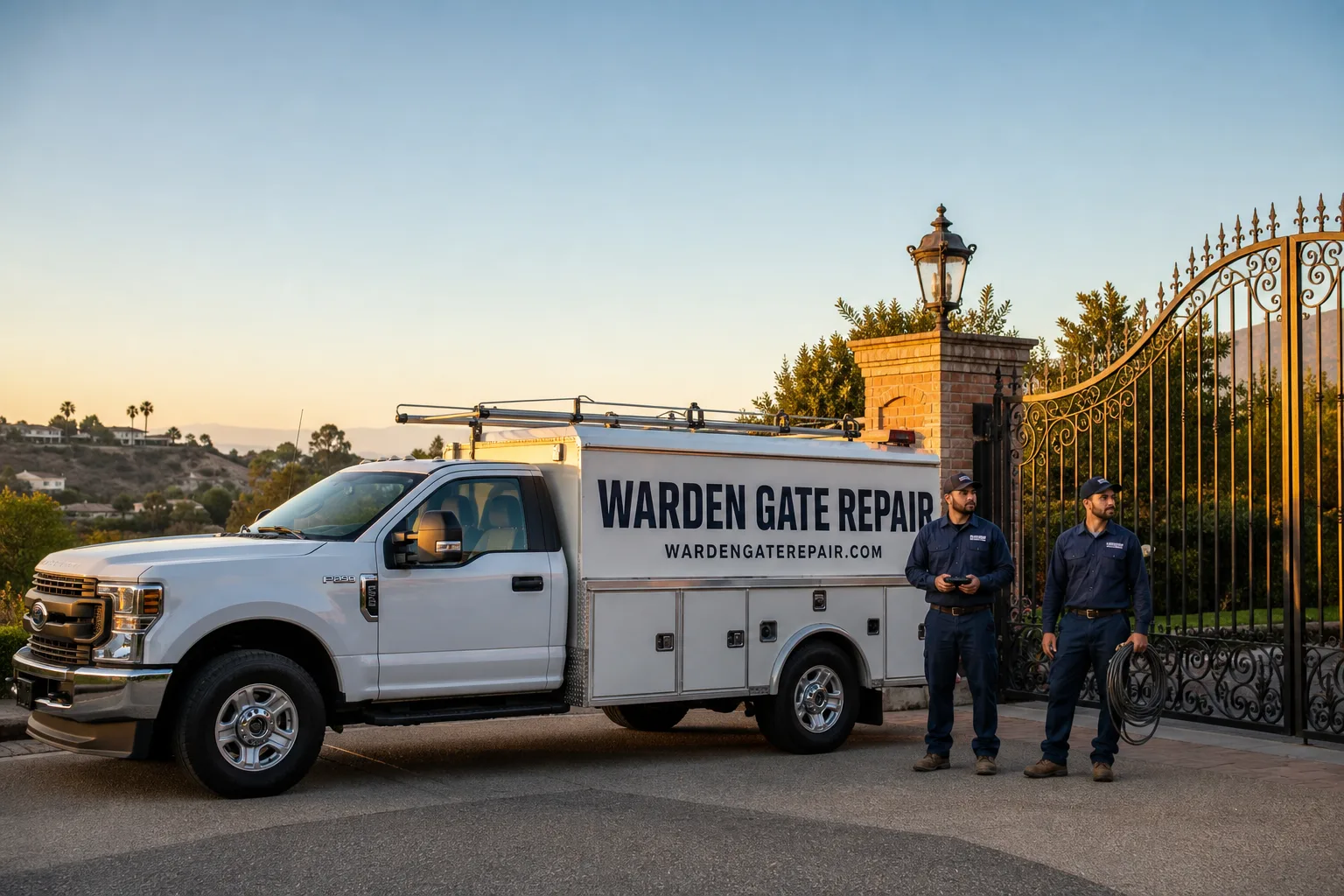
Free on-site gate assessment - hinges, posts, and your LiftMaster or Nice gate operator checked before anything is quoted
The assessment is free and the quote is the invoice.

 Before
 After
After Before
 After
After Before
 After
AfterGate Reverses Immediately: What It Means and How to Fix It
When your gate starts to open and then immediately reverses direction, the operator’s safety system has detected something it doesn’t like – a real obstruction, a false signal, or a mechanical problem the motor refuses to fight through. This is almost never random. The gate is doing exactly what it was programmed to do: stop and back off rather than force its way through whatever is in the way.
What’s Happening
A gate that reverses immediately after starting has triggered its auto-reverse circuit. This happens when the operator reads too much resistance – from an obstruction, a misaligned sensor, a limit switch set too tight, or a mechanical drag the motor can’t overcome. The gate isn’t broken in a random way; it’s responding to a specific input.
Every gate operator – whether it’s a LiftMaster, FAAC, Viking, or Mighty Mule – has a force threshold built in. When the motor senses that moving the gate takes more effort than it should, it stops and reverses to prevent damage and protect anyone who might be in the path. That protection is exactly what you want it to do. The problem is figuring out why the threshold is being crossed, because the fix is completely different depending on the cause. A dirty sensor lens is a five-minute clean. A broken spring or worn gear inside the operator is a repair job. Both produce the same symptom from where you’re standing.
Why It Happens
Safety Sensor Obstruction or Misalignment
Most swing and slide gates have photo-eye sensors near the gate path – small transmitter/receiver pairs that beam an invisible line across the opening. If that beam is interrupted or the sensors have shifted out of alignment with each other, the operator reads a blocked path and reverses. You can often spot this yourself: look at the sensor heads and check whether their indicator lights are solid (aligned) or blinking (not seeing each other). Dirt, spider webs, moisture, or even a leaf sitting across the lens is enough to cause a false reading.
Limit Switch Set Incorrectly
Limit switches tell the operator where “fully open” and “fully closed” are. If the open-limit is set too short, the gate hits its programmed stopping point before it finishes traveling and the motor interprets that resistance as a blockage – then reverses. This often develops gradually after a gate post shifts slightly or after a previous repair disturbed the operator settings. The sign is a gate that travels partway, then reverses at almost exactly the same point every time rather than at random.
Mechanical Drag: Hinges, Track, or Wheels
A gate that’s hard to push by hand – one that drags on the ground, has a stiff hinge, a bent track, or a wheel that no longer rolls freely – puts extra load on the motor. The operator hits its force limit and reverses before the gate finishes moving. Grab the gate by hand (with the operator disconnected at the manual release) and push it through its full travel. If it drags, grinds, or takes noticeably more effort at one point, you’ve found the mechanical resistance the operator is responding to. Do not disconnect the manual release if your gate uses a counterbalance spring you can’t clearly see and identify – springs under tension can release suddenly and cause serious injury. Call us first.
Operator Force or Sensitivity Setting Drifted
Gate operators have adjustable force and sensitivity settings, usually accessed through dip switches or a digital menu on the control board. These settings can drift over time, especially after a power surge, a low-battery event on a solar-powered unit, or a firmware reset. When the sensitivity is set too high, the gate treats normal operating resistance as an emergency and reverses. This is a technician-level adjustment on most systems – changing it wrong in the other direction turns off a genuine safety feature, so it’s not a good one to experiment with on your own.
What to Do Right Now
- Stop cycling the gate. Repeatedly pressing the button to force the gate through a reverse loop puts stress on the motor and the mechanical components. One or two test cycles to confirm the symptom is enough. After that, leave it alone.
- Look at the sensor lights. Walk to each photo-eye sensor (they’re usually mounted low, near the gate posts or on the gate frame). If either light is off or blinking, that’s your likely culprit. Wipe the lens with a dry cloth – sometimes that’s genuinely all it takes. Do not move or adjust the sensor mount itself unless you’re comfortable re-aligning both heads.
- Check for obvious obstructions. Scan the gate’s full travel path for anything that shouldn’t be there: a hose, a trash can, a branch, packed dirt at the base of a slide gate. Remove anything you can safely clear without stepping into the gate’s swing path while it’s powered.
- Test the gate by hand – carefully. With power off at the operator (use the manual release cord or lever, following your operator’s manual), push the gate through its full range of motion. Note where it binds or drags. If you can’t find the manual release, or if the gate has a visible torsion spring or cable under tension, stop here and call us. Don’t try to move a gate that’s fighting you through a spring system.
- Photograph what you see. A photo of the sensor lights, the gate track or hinge, and the operator’s control board (if visible) gives your technician a head start before they even arrive. Text or email those to us when you call.
How We Fix It
When your local Warden Gate Repair team arrives, the first thing the technician does is run the gate through a diagnostic cycle while watching the operator’s response – not just the gate’s movement. That tells them whether the reversal is coming from a sensor fault, a limit setting, a mechanical load issue, or an internal operator problem.
Sensor alignment and limit adjustments are usually resolved in the same visit. Mechanical repairs – worn wheels, a dragging hinge, a bent track – are also handled on site in most cases. If the operator’s control board or motor has failed internally, the technician will identify the exact part and give you a written price for the repair before anything comes apart. That’s not a courtesy; it’s how every Warden job works. You see the number, you agree to it, then the work starts.
Most reversing-gate repairs fall under our standard gate repair service. When the operator itself is the fault, it becomes an electric gate repair or gate motor repair job. Either way, the written price comes first, and every repair is covered by the 365-Day Done Right Promise: if it fails within a year, the return visit is free.
Most visits run one to two hours, depending on what the diagnostic turns up.
Frequently Asked Questions
It depends on which way it’s stuck. A gate that reverses to the closed position and stays closed is a security issue – you may not be able to get in or out easily – but it’s not an immediate physical hazard. A gate that reverses to the open position and stays open is a security and safety problem that should be addressed the same day, especially if you have children or pets. Either way, don’t leave it cycling unattended. Call (828) 426-7081 and your local Warden team can help you figure out the right level of urgency based on what you’re seeing.
In most cases, yes. Sensor alignment, limit switch adjustments, and minor mechanical repairs are typically handled in a single visit. If a part needs to be ordered – a control board for a less common operator model, for example – the technician will tell you that clearly before any work starts, along with the written price for the full repair. Call (828) 426-7081 to reach a live person right now and get your visit scheduled.
Unlikely, but repeated reversal cycles can trip a thermal overload in some operators – a built-in protection that shuts the motor down when it overheats. If that happened, the motor may restart normally after a 15-30 minute cool-down period. If it does, that’s still a sign that something was causing excess load, and it’s worth having a technician check it before the pattern repeats. One cool-down period and one clean test cycle is reasonable; more than that is motor wear you don’t want.
Yes, always. Written price before any work starts is not a selling point we add to some jobs – it’s how every Warden job works, no exceptions. Your technician will diagnose the fault, put the repair price in writing, and wait for your go-ahead before any part comes off the gate. There are no surprise line items at the end. The price you agreed to is the price on the invoice.
Get It Fixed
Call (828) 426-7081 right now – a live person answers 24 hours a day, every day of the year, no voicemail. Or book online and your local Warden Gate Repair team will confirm your visit, send you your technician’s name and photo before they arrive, and show up ready to fix it – price in writing, work guaranteed.
Written by Cole Rafferty, Owner at Warden Gate Repair, serving communities nationwide as part of the Threshold Group family since 2008.
What Our Customers Say
"Fair price and no pushing a whole new gate when all I needed was a new motor capacitor."
- Shirley A."The vetted tech thing was important since our gate protects the whole property. Careful, polite, and walked me through every safety sensor."
- Russell W."Swing gate wouldn't latch after the hinge sagged. He re-hung it, adjusted the hinge pins, and fixed the latch. Quoted before starting."
- Annette R.