
Last updated October 9, 2026
Free on-site gate assessment - hinges, posts, and your LiftMaster or Nice gate operator checked before anything is quoted
The assessment is free and the quote is the invoice.

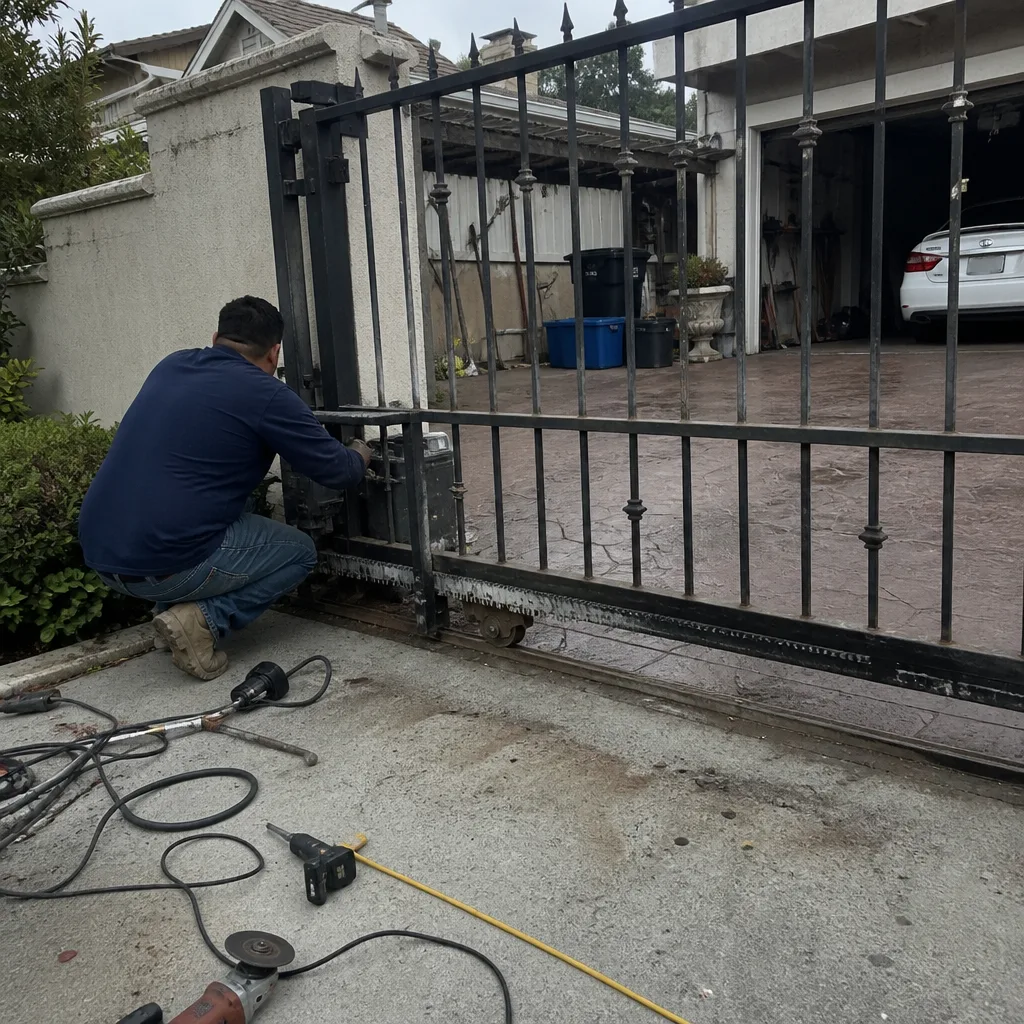 Before
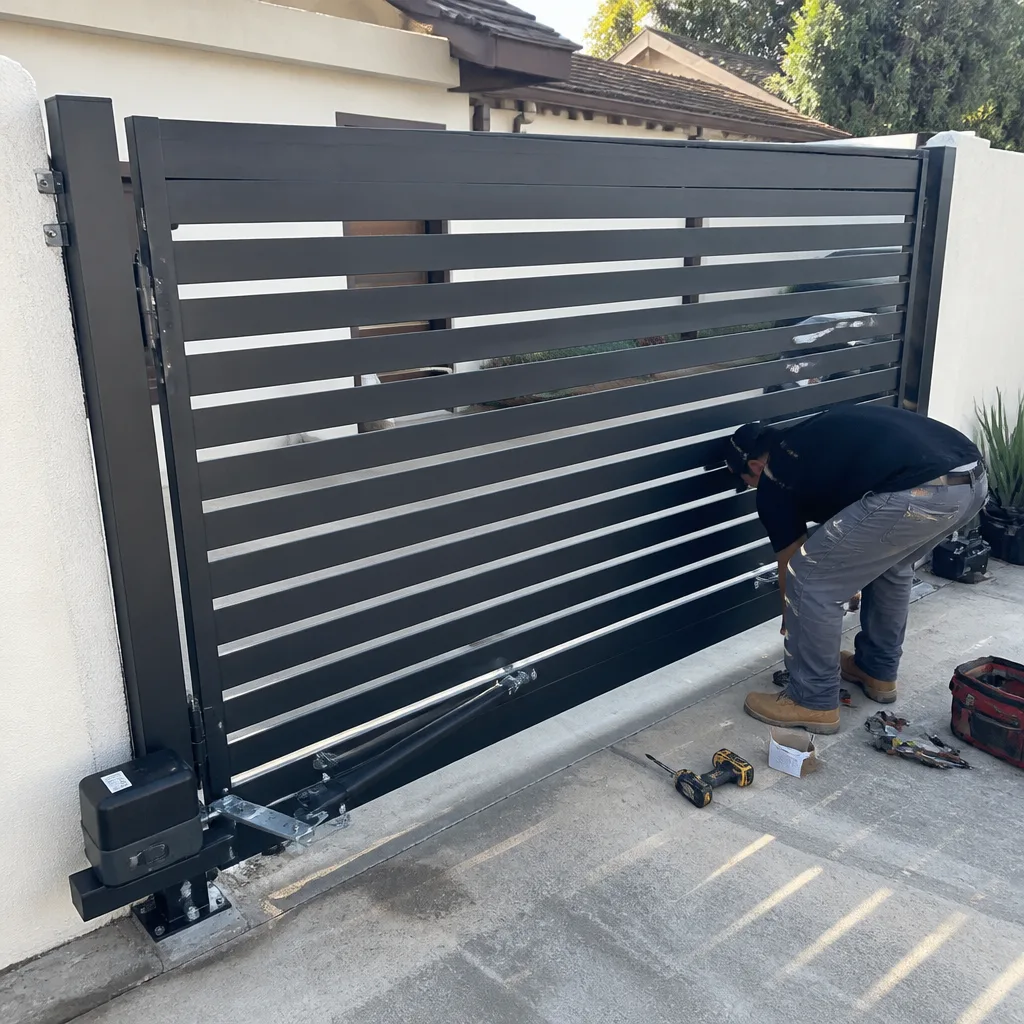 After
After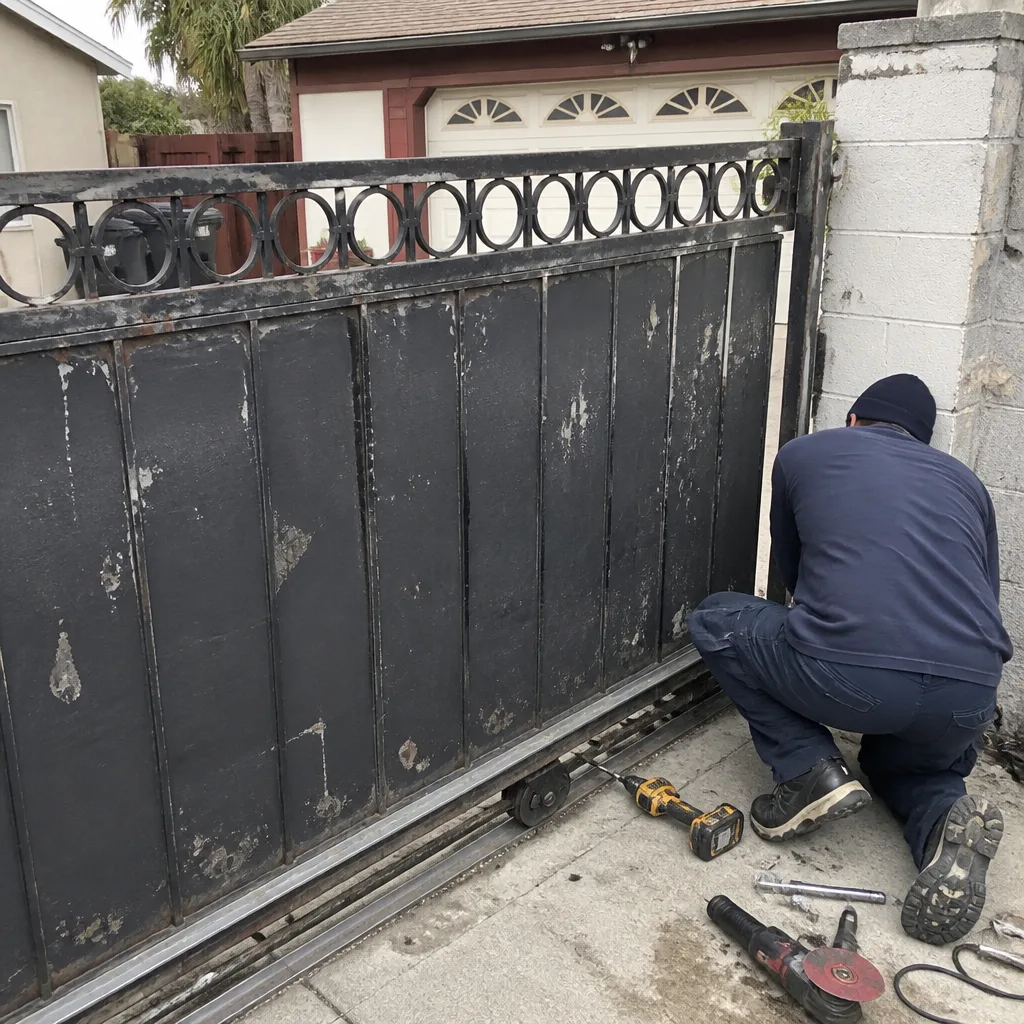 Before
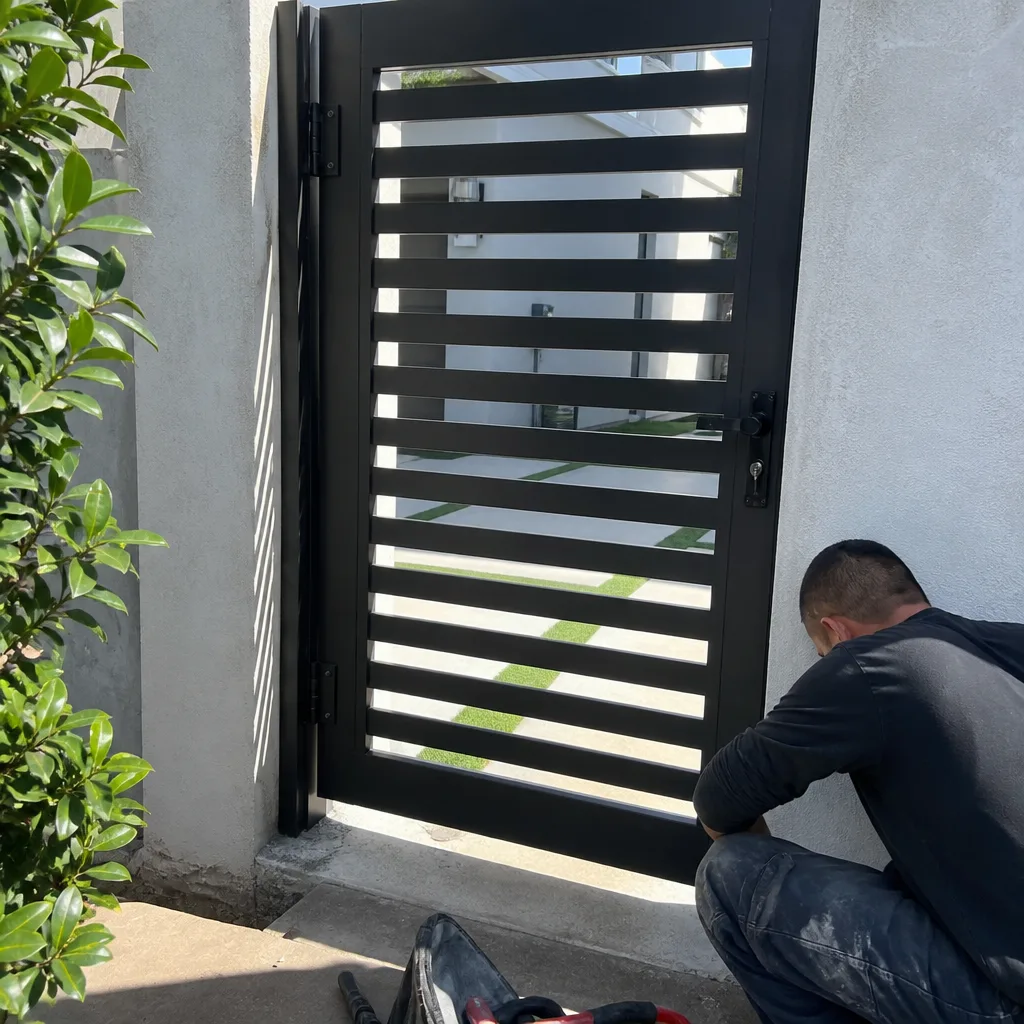 After
After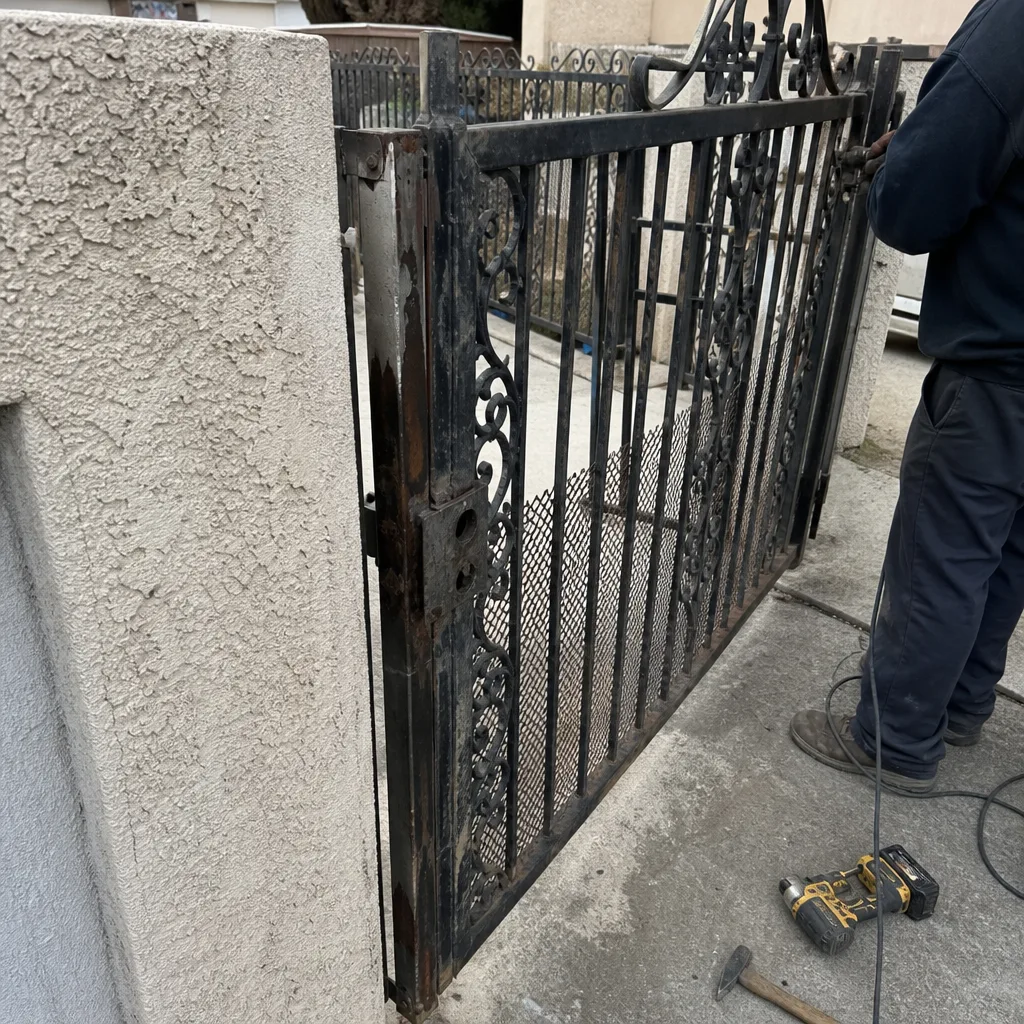 Before
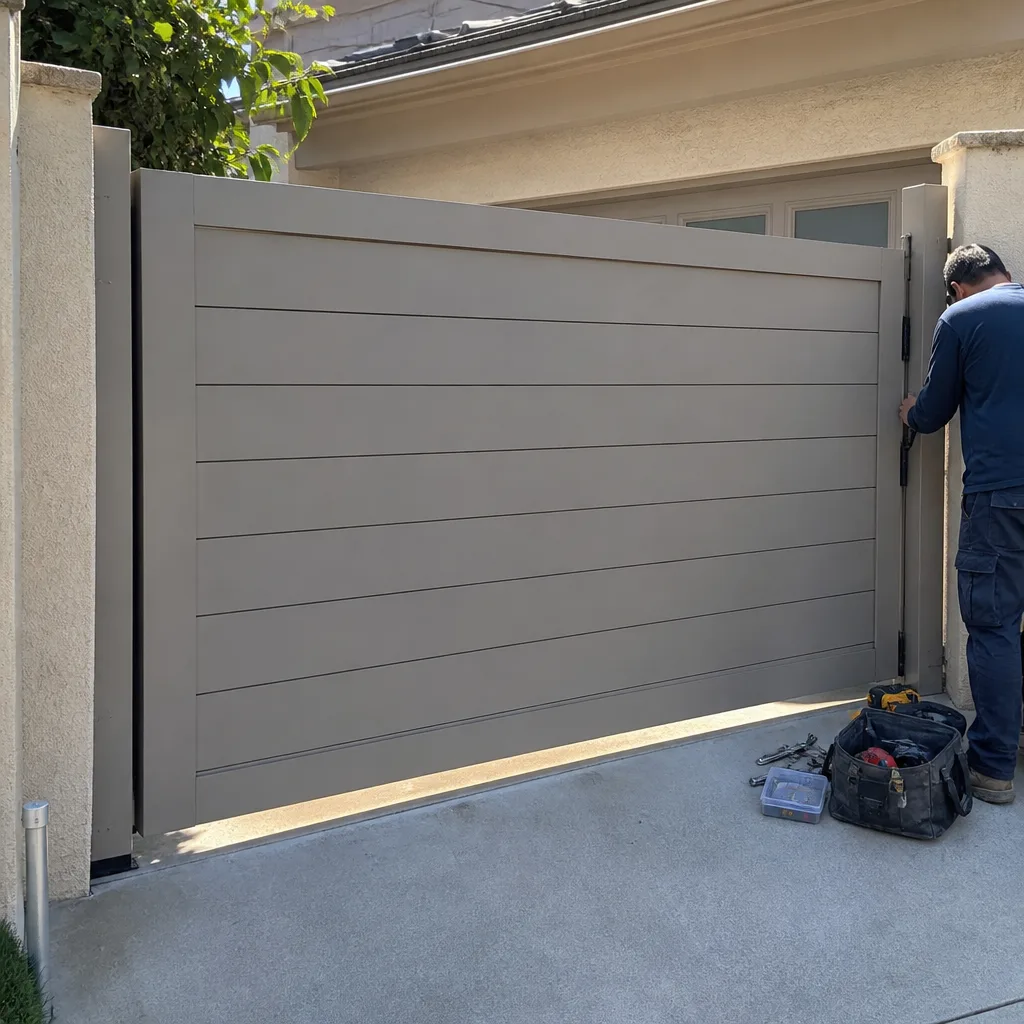 After
AfterDIY vs Professional Electric Gate Repair: What’s Safe to Do Yourself
Replacing a gate opener remote takes about five minutes and is completely legal for any homeowner to do. Rewiring that same opener’s control panel without a C-10 electrical license can technically void your homeowner’s insurance policy if a later electrical fault causes damage. Most Los Angeles homeowners don’t know that line exists until something goes wrong. This guide walks you through exactly what you can legally and safely do yourself, what requires a licensed technician under California law, and how to avoid the insurance trap that catches more people than faulty capacitors ever do.
Quick Answer
Safe DIY electric gate repairs are limited to routine, non-electrical tasks: replacing remote batteries, reprogramming remotes, cleaning photo-eye sensors, tightening visible hardware, and clearing debris from the gate track. Anything involving wiring, control boards, loop detectors, or motor internals requires a C-10 licensed electrical contractor in California, and doing it yourself can void your homeowner’s insurance coverage for any resulting damage. When in doubt, call a Gate Repair specialist for a written estimate before touching anything connected to line voltage or low-voltage control wiring.
Table of Contents
- What’s Actually Safe to DIY: The Complete List
- California Licensing Law: Where the Legal Line Is Drawn
- The Insurance Implication Most Homeowners Miss
- Tasks That Require a Licensed Technician, No Exceptions
- How to Verify a Gate Repair Company’s C-10 License in Under 60 Seconds
- Why Los Angeles Gates Fail Differently: Climate and Code Considerations
- DIY vs Professional: A Real Cost Comparison for Los Angeles Homeowners
- Common Mistakes to Avoid
- When to Call a Professional
- Frequently Asked Questions
What’s Actually Safe to DIY: The Complete List
Let’s start with the good news. There are several electric gate maintenance tasks that any homeowner in Los Angeles can handle without a license, without special tools, and without risking an insurance nightmare. These tasks sit on the user-maintenance side of the line, and manufacturers like BFT and Linear actually expect owners to perform them.
Remote control battery replacement. If your gate opener remote works intermittently or only from close range, the coin cell battery is almost always the culprit. Open the remote case with a small screwdriver, note the battery type (CR2032, A23, etc.), and swap it. This takes five minutes and costs about $2 to $6 per battery at any Los Angeles hardware store.
Remote reprogramming after battery replacement. Several brands, including Linear and Ghost Controls, require you to resync the remote after a battery swap. The process usually involves pressing a “learn” button on the opener control board and then pressing a button on the remote. Your owner’s manual has the exact sequence. This is user-level maintenance, not electrical work.
Photo-eye sensor cleaning. The safety sensors at the base of your gate get dusty, spider-webbed, and occasionally splashed with sprinkler water. If your gate reverses for no reason or refuses to close, clean both sensor lenses with a soft cloth and check for alignment. This is the single most common “repair” that isn’t actually a repair at all. In areas like the San Fernando Valley, fine dust accumulates on sensor lenses within weeks during dry season.
Gate track and roller cleaning. Slide gates accumulate leaves, dirt, and small rocks in the track. Clearing debris and wiping down the track helps the gate move freely and prevents motor strain. Use a leaf blower or broom, not a pressure washer, which can force water into the motor housing.
Visual inspection of visible hardware. Tightening loose bolts on gate hinges, checking for rust on visible brackets, and lubricating wheels with a silicone-based lubricant are all safe homeowner tasks. Avoid petroleum-based lubricants, which attract dust and gum up over time.
Antenna repositioning. If your remote range has dropped significantly, check the small antenna wire on the opener control box. Sometimes it gets bent, pinched, or moved during other work. Straightening it or repositioning it away from metal surfaces is safe and often restores range instantly. This is especially common on BFT and Viking units installed in metal enclosure boxes.
California Licensing Law: Where the Legal Line Is Drawn
Most DIY vs Professional Gate Repair: What’s Safe to Do Yourself guides focus on skill level. They ask questions like “are you handy?” and “do you own a multimeter?” The real question in California is simpler and more serious: are you legally permitted to do this work?
California requires any contractor performing electrical work on a property they don’t own to hold a C-10 Electrical Contractor license issued by the Contractors State License Board (CSLB). This includes low-voltage systems like electric gate openers, intercoms, keypads, and loop detectors. The C-10 classification covers “electrical work” broadly defined, and the CSLB has consistently treated access control and gate automation wiring as falling under that umbrella.
Here’s what that means for you as a homeowner:
- You can work on your own property without a license. California law exempts homeowners from the C-10 requirement when working on their own residence. This is why the state won’t stop you from rewiring your own gate opener.
- Hiring unlicensed help is the real risk. If you pay a handyman or “gate guy” without a C-10 license to rewire your opener, you’re hiring an unlicensed contractor, which is illegal in California and carries penalties for the contractor.
- Low-voltage doesn’t mean unregulated. There’s a persistent myth that low-voltage work (under 50 volts) doesn’t require a license. The CSLB doesn’t agree. Gate openers, intercoms, and loop detectors all require C-10 licensing, even though they run on low voltage.
- Manufacturer warranties may require licensed installation. Viking and BFT both state in their warranty terms that installation must be performed by qualified personnel. An unlicensed install can void the warranty on a $1,500 opener.
At Warden Gate Repair home, we send out C-10 licensed technicians on every electrical job because we’ve seen too many Los Angeles homeowners get stranded when an unlicensed repair fails and the manufacturer refuses warranty coverage.
The Insurance Implication Most Homeowners Miss
Here’s the scenario that lands in our voicemail more often than we’d like to admit. A homeowner in Sherman Oaks replaces a control board on a Viking opener themselves. Three months later, a wiring fault in that board area causes a small fire that damages the gate, the wall, and part of the garage. The homeowner files an insurance claim. The insurance adjuster asks who replaced the board. The homeowner says “I did.” The claim gets denied.
That’s not a hypothetical. Most California homeowner’s insurance policies contain an exclusion for damage caused by “unlicensed electrical work” or “work performed in violation of building codes.” If the damage can be tied back to electrical work that required a license and wasn’t performed by a licensed contractor, the insurer has grounds to deny the claim.
Before you open the control box on your gate opener, read your policy. Look for language like:
- “Electrical work” paired with “licensed contractor” requirements
- Exclusions for “faulty workmanship” or “negligent repairs”
- Requirements to disclose “material changes” to the property’s electrical systems
What insurers care about is demonstrated competence and accountability. A licensed contractor carries their own liability insurance and a license bond. If their work causes damage, their insurance covers it, not yours. That’s the whole point of the licensing framework, and it’s why insurance companies write exclusions for unlicensed work. In Los Angeles, where many homes have newer electrical panels and higher property values, a denied claim on a gate-related fire can mean a five-figure out-of-pocket repair.
The practical takeaway: if the work involves a screwdriver on a control board, it’s insurance-relevant. If it involves a battery in a remote, it isn’t.
Tasks That Require a Licensed Technician, No Exceptions
Now for the list that protects your house, your insurance claim record, and your family’s safety. These tasks require a C-10 licensed technician, regardless of how confident you are with electrical work.
- Any wiring work inside the opener control box. The control board receives line voltage from your panel. If that panel connection isn’t done correctly, you’re looking at fire risk, not just a dead gate. This is C-10 territory, full stop.
- Control board replacement. A control board swap sounds simple, and the board itself may only cost $150 to $400. But the board interfaces with limit switches, safety sensors, keypads, and the motor capacitor. If any of those connections are wrong, you can destroy the new board instantly. We’ve replaced boards in Los Angeles that homeowners “installed” and fried within 48 hours. The total cost ends up higher than hiring us from the start.
- Loop detector installation. Free-exit loop detectors, the wire loops cut into your driveway, require a saw-cut trench, a specific number of wire turns per loop size, and a sealant that survives Los Angeles’s sun and rain cycles. Get the turns wrong and the gate won’t detect your car. Get the depth wrong and a heavy vehicle cracks the loop over time. This is genuinely technical work.
- Motor repair or replacement. The gate motor (the box that slides or swings your gate automatically) contains capacitors that can hold a charge after power is disconnected. An amateur can get a serious shock. Motor replacement also involves setting limit switches and force adjustments that, if set wrong, create an entrapment hazard. The same motor that’s too weak to open the gate can be strong enough to crush a child if force settings are wrong.
- Safety edge and photo-eye wiring. Your gate’s safety devices are the only thing preventing it from closing on a person, a car, or a pet. If these are wired incorrectly or bypassed, you’ve created a serious hazard. Entrapment deaths involving gates are rare but real, and they almost always trace back to improperly installed or bypassed safety devices.
- Any line-voltage work on the gate’s power supply. If the problem is at the breaker, the outlet, the conduit, or the wire run from your panel to the opener, that’s standard electrical work requiring a C-10 license. Don’t open the panel.
For any of these, the right move in Los Angeles is to call a gate company that sends a licensed technician. Our Gate Repair in Los Angeles team handles these daily, and we provide a written price before any work starts.
How to Verify a Gate Repair Company’s C-10 License in Under 60 Seconds
You’ve decided to hire a professional. Good. Now verify they’re actually licensed. In California, this is faster than brewing coffee.
The CSLB (Contractors State License Board) maintains a free, public license lookup tool at cslb.ca.gov. Here’s the 60-second process:
- Go to cslb.ca.gov and click “Check a License” on the homepage.
- Enter the company name or license number. If you have the license number, use it. It’s the fastest path to the right record.
- Look for the classification. You want to see “C-10” (Electrical) in the classifications list. A gate company that only has a C-61/D-28 (Doors, Gates, and Activating Devices) license can work on mechanical gate hardware but should not be doing electrical wiring. Many gate companies hold both, but the C-10 is the one that matters for electrical work.
- Check the license status. It should say “Active.” If it says “Suspended,” “Expired,” or “Revoked,” don’t hire them.
- Check the bond and insurance status. The detail page shows whether the company has a current contractor’s bond and workers’ compensation insurance. Both should be “Active.”
- Match the business name. Make sure the name on the license matches the name on the invoice you’ll be paying. If they don’t match, ask why.
We maintain full C-10 credentials through the CSLB, and we encourage every Los Angeles homeowner to verify that before we arrive. It’s your right, and it’s the only way to be sure the person at your gate is who they say they are. In our experience, we’ve also found that verified licensing is just one layer of truth. If you want to know exactly who’s coming to your door, ask for a name and photo before the visit, not just a license number. That’s the Electric Gate Repair in Los Angeles standard we enforce on every job.
Why Los Angeles Gates Fail Differently: Climate and Code Considerations
Los Angeles is not a gentle place for gate hardware. We see failure patterns here that gate owners in, say, Seattle or Phoenix never experience. Understanding these patterns helps you know what’s preventable and what’s inevitable.
Sun damage to control boards. Los Angeles gets about 284 sunny days per year. Gate control boxes, especially dark metal ones, bake in that sun. Internal temperatures can exceed 140°F on summer afternoons. We see capacitor failures and soldered joint cracks on sun-exposed boards far more often in the Valley than in coastal neighborhoods. If your control box faces west, it’s getting the worst of it.
Santa Ana wind damage. Santa Ana winds push gates past their normal travel limits, bend tracks, and loosen hardware. After a strong Santa Ana event, we get a spike in calls for gates that won’t close, won’t open, or make grinding noises. Most of that damage is mechanical, not electrical, but the wind also whips debris into photo-eye sensors and can knock them out of alignment.
Coastal corrosion. Homes within a few miles of the coast, in neighborhoods like Pacific Palisades or Playa del Rey, deal with salt air corrosion on gate hinges, motor housings, and wiring terminals. That corrosion causes resistance in electrical connections, which trips safety systems or causes intermittent motor operation. A homeowner can clean visible rust, but internal corrosion requires professional attention.
Hard water and irrigation spray. Los Angeles tap water is hard, and irrigation overspray onto gate tracks and motor housings leaves mineral deposits that accelerate wear. If your sprinklers hit your gate, adjusting them is one of the best preventive maintenance steps you can take, and it’s free.
Permit considerations. In Los Angeles, replacing an existing gate opener typically doesn’t require a city permit, but adding a new gate or a new electrical run to a gate often does. If you’re installing a gate where none existed, or running new conduit, check with LADBS before you start. An unpermitted electrical run can complicate a future home sale, and Los Angeles buyers and their inspectors do check.
DIY vs Professional: A Real Cost Comparison for Los Angeles Homeowners
Let’s talk about what these repairs actually cost, because the decision usually comes down to money. Here are real price ranges our team sees in Los Angeles in 2025.
| Task | Typical DIY Cost | Typical Licensed Tech Cost in Los Angeles | Verdict |
|---|---|---|---|
| Remote battery replacement | $2 – $6 | $40 – $75 (if you have us do it during a service call) | DIY clearly wins |
| Remote reprogramming | $0 (manual + time) | $75 – $125 | DIY if you have the manual |
| Photo-eye sensor cleaning | $0 (cloth + time) | $95 – $150 (if misdiagnosed as sensor failure) | DIY first, call only if cleaning doesn’t work |
| Track cleaning and lubrication | $10 – $25 (silicone lubricant) | $125 – $200 | DIY is fine |
| Control board replacement | $150 – $400 (board only, risk of frying it) | $450 – $850 (board + labor + testing) | Professional, always |
| Gate motor replacement | $500 – $900 (motor only, high risk) | $1,200 – $2,400 (motor + labor + safety setup) | Professional, always |
| Loop detector installation | Not realistic for DIY | $600 – $1,200 (saw cut, loop wire, sealant, detector) | Professional, always |
Here’s the part most cost guides skip: the DIY savings only materialize when nothing goes wrong. A botched control board install can turn a $600 professional job into a $1,500 emergency repair. A botched motor install can cost more than the pro job would have in the first place, plus you’ll own the liability. At Gate Motor Repair in Los Angeles, we quote every job in writing before we touch a screwdriver, so you know the number before you commit. If you’re weighing DIY against professional work, get the professional number first. It’s usually closer to the DIY number than you think, and it comes without the downside risk.
Common Mistakes to Avoid
- Assuming low voltage means low risk. Low-voltage wiring still lives in a control box that connects to line voltage. Touching the wrong terminal on a live board can shock you, and the capacitors in gate motors can hold a charge after power is off. Low voltage doesn’t mean no voltage.
- Bypassing safety sensors to “fix” a gate that won’t close. If your gate won’t close, the sensors are doing their job. Bypassing them is dangerous and illegal. The problem is almost always dirty lenses, misalignment, or a failed sensor, not a sensor that needs to be removed from the circuit.
- Buying aftermarket control boards from unknown online sellers. A $40 knockoff board for your BFT or Linear opener is not the same as the OEM part. Aftermarket boards fail faster, lack proper surge protection, and sometimes don’t speak the same voltage language as your existing accessories. You’ll spend more replacing it twice than buying the right part once.
- Using a pressure washer on your gate. Pressure washers force water into motor housings, control boxes, and wiring connections. In Los Angeles, where water dries fast but leaves mineral residue, a pressure wash can shorten your opener’s life by years. Use a hose and a soft brush instead.
- Ignoring a gate that’s gotten slower over time. A gate that opens slower than it used to is a gate with a problem, usually motor strain from a failing mechanism or a capacitor on its way out. Waiting until it stops completely turns a $200 repair into a $1,500 replacement.
- Hiring the cheapest licensed electrician rather than a gate specialist. A C-10 license means the electrician knows electrical code. It doesn’t mean they know Ghost Controls limit settings or Viking force adjustment. Gate-specific experience matters. We service nine major brands exclusively, and the right parts and knowledge arrive together.
- Failing to document who did previous work on the gate. If someone worked on your gate before you bought the house and there’s no record, you don’t know if safety settings are correct. If you inherited a gate with your Los Angeles home purchase, have it inspected by a gate professional before assuming it’s safe.
When to Call a Professional
Call a professional when the problem involves wiring, control boards, motors, safety sensors that aren’t responding to cleaning, or any issue you can’t diagnose within the first ten minutes of looking at it. Call a professional when the gate is half-open and won’t move, when the motor hums but the gate doesn’t move, when the gate reverses immediately after closing, or when you smell burning near the control box. Call a professional when the CSLB license lookup for the last company that worked on your gate comes back empty. And call a professional when you want the work done right the first time, with a written price before anything starts and a written guarantee after it’s done. Warden Gate Repair offers free estimates in Los Angeles, call (828) 426-7081.
Frequently Asked Questions
Legally, yes, you can work on your own property without a C-10 license, but if that work causes damage, your homeowner’s insurance may deny the claim under the unlicensed electrical work exclusion. We recommend leaving all wiring, control board, and motor work to a licensed C-10 technician, whether in Los Angeles or anywhere else in California. For related decisions, see our comparison of DIY vs Professional Gate Motor Repair: What’s Safe to Do Yourself.
Remote battery replacement, remote reprogramming following the manufacturer’s manual, photo-eye sensor cleaning, track cleaning, and visual hardware inspection are all safe and won’t void your warranty. Anything involving the control box internals, wiring, or motor should be left to a professional, and manufacturers like Viking and BFT may void the warranty if unlicensed work is found.
Look them up on the CSLB website at cslb.ca.gov using the “Check a License” tool. Enter the company name and confirm they hold an active C-10 Electrical classification, not just a C-61/D-28 gate and door license. A C-10 license covers electrical work; the D-28 covers mechanical gate work only. At Warden Gate Repair, our technicians are C-10 licensed and identifiable by name and photo before they arrive.
Repairing or replacing an existing gate opener typically doesn’t require a city permit in Los Angeles. However, installing a new gate where none existed, running new electrical conduit, or adding a new power supply often does. Check with LADBS before starting a new installation project.
Electric gate repair in Los Angeles typically costs between $150 and $850 depending on the problem. Sensor cleaning or remote reprogramming runs $95 to $150, control board replacement runs $450 to $850, and motor replacement runs $1,200 to $2,400. Any company doing this work should provide a written price before starting, and Warden Gate Repair does exactly that. Call (828) 426-7081 for an exact quote, estimates are free.
You can legally do it on your own property, but we don’t recommend it. Gate motors contain capacitors that hold a charge after power is disconnected, and setting the limit switches and force adjustments correctly requires specific training. Incorrect force settings create an entrapment hazard. This is one repair where the safety stakes and the insurance stakes are both too high for DIY.
The Bottom Line
The DIY line on electric gate repair isn’t drawn by how handy you are. It’s drawn by what the work touches. Remote batteries, sensor lenses, and track debris are yours to handle. Wiring, boards, motors, and safety systems belong to a licensed professional. California’s C-10 licensing requirement exists for a reason, and your insurance policy quietly depends on it. Before you open that control box, verify what’s inside, read your policy’s exclusions, and get a written professional quote for comparison. At Warden Gate Repair, we’ve been doing this work in Los Angeles since 2008, and we quote every repair in writing before the first tool comes out. When the work is above the DIY line, Warden Gate Repair home is one call away at (828) 426-7081.
Written by Cole Rafferty, Owner at Warden Gate Repair, serving Los Angeles since 2008. Browse our more guides & resources.